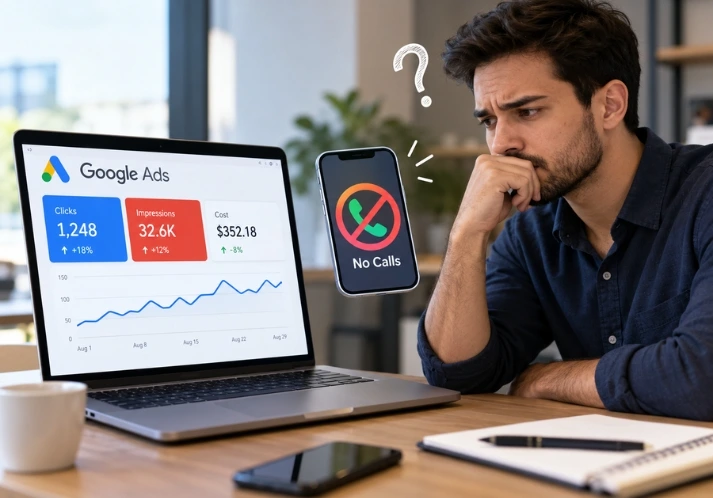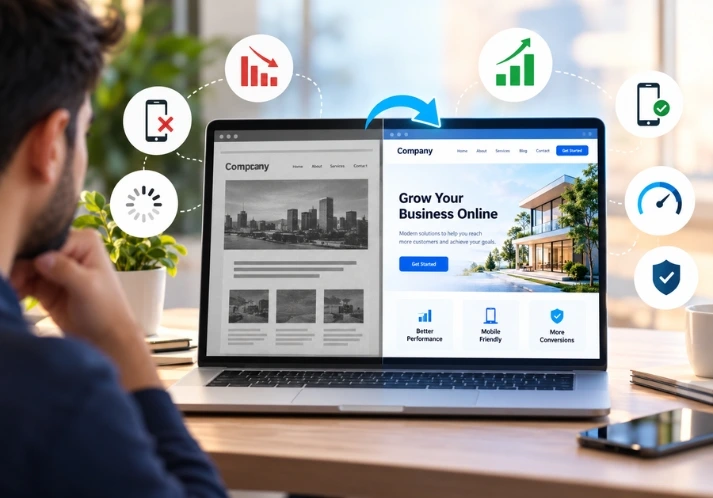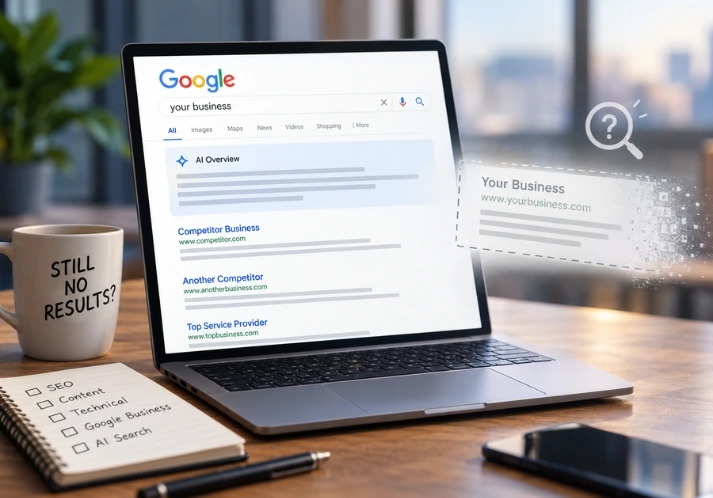

A Melbourne business owner called us in July with a familiar complaint: “My site looks better than my competitor’s, and they’re getting three times the enquiries.” He’d spent good money on design. Clean layout, nice photography, a logo that actually looked professional. And still – nothing. That’s not a design failure. It’s what happens when a website is built to be looked at instead of built to be used, and it’s the reason your website isn’t generating leads even though it looks the part.
It’s Not Design. It’s What Happens After Someone Lands.
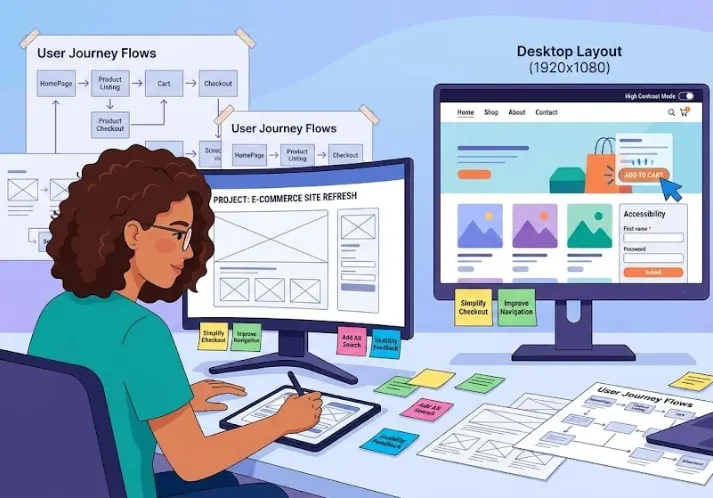
A website that looks good and a website that converts are solving two different problems. Design answers “does this look credible?” Conversion answers “can a stranger figure out what to do next, in under ten seconds, without thinking about it?” Most sites nail the first question and never ask the second. Visitors land, scroll, feel vaguely reassured, and leave. No enquiry, because nothing on the page told them what to do or made it easy to do it.
We’ve rebuilt enough sites now to say this with confidence: the businesses that struggle rarely have an ugly website. They have one that was designed for approval – from the owner, from the board, from whoever signed off on the brief – instead of for the visitor who’s comparing three options on their phone at 9pm.
Reason 1: There’s No Clear Path From Click to Enquiry
Open your own homepage and time yourself. Can you find the phone number in five seconds? Is there a single, obvious next step, or six competing buttons all shouting for attention? A lot of Melbourne small business sites we’ve audited have a “Contact Us” link buried in the nav and nothing else. No calculator, no quote form, no chat, no clear CTA above the fold. The visitor has to work to become a lead. Most won’t bother.
Reason 2: The Site Was Built for the Wrong Search Intent
This one’s sneaky because it looks like a traffic problem when it’s actually a targeting problem. You can rank for “what is SEO” and get 2,000 visits a month from people doing research, not buying. Meanwhile the page that would actually convert – “SEO agency Melbourne pricing,” say – gets ignored because nobody optimised it. Traffic volume feels good on a dashboard. It means nothing if the people arriving aren’t ready to enquire.
We audit a lot of Melbourne sites where the blog gets all the traffic and the service pages get almost none, which is the opposite of what should happen. The blog answers “what is,” the service page answers “who do I hire,” and only one of those visitors is close to filling in a form. If your internal links all point traffic toward the blog and rarely back toward the page with the enquiry form on it, you’re training Google – and your visitors – to treat you as a source of free information rather than someone to hire.
Reason 3: Forms and CTAs Add Friction Instead of Removing It
Ten fields to ask for a quote. A “Submit” button that gives zero feedback when clicked. A contact form that emails a generic inbox nobody checks until Monday. Every extra field, every vague label, every slow response is a small tax on the visitor’s patience – and patience for filling out forms is close to zero in 2026. We’ve watched form completion rates jump just from cutting a field count from nine down to four. Nothing else changed. Same traffic, same design, more leads.
Reason 4: Mobile Is an Afterthought, and Mobile Is Most of Your Traffic
Most Australian service businesses now get 60%+ of their traffic on mobile. If the phone number isn’t tappable, if the form fields zoom in awkwardly, if a button sits half a millimetre from another one – that’s not a small usability quirk, it’s lost enquiries. A site that looks polished on a 27-inch monitor during the pitch meeting can feel clunky on the device most people actually use to find you.
Reason 5: Nobody Follows Up Fast Enough
Here’s one people rarely connect to “the website problem.” Someone fills in your form at 11pm. Nothing happens until Tuesday morning, three days later, when someone finally checks the inbox. They’ve already booked with a competitor who called back in twenty minutes. Studies on lead response time keep landing on the same number: contact within five minutes and you’re dramatically more likely to convert than if you wait even half an hour. A beautiful website with a slow, manual follow-up process is still a leaky bucket – the leak just happens after the form submit, where it’s invisible in most audits.
Reason 6: The Website Was Treated as a One-Off Project
A site gets built, launched, and left alone for two years while the business, its offers, and its competitors all move on. Broken links pile up. Old pricing sits on a page nobody remembers to update. Plugins go stale. None of this shows up as an obvious crash – it shows up as a slow, quiet decline in both trust and rankings. Businesses that treat their site as a living asset, reviewed and adjusted every few months, consistently outperform ones that treat launch day as the finish line.
What This Looked Like for a Real Client
We worked with Ace Finance Solutions, a mortgage broker based in Melbourne, on exactly this problem. Their site looked fine – professional enough, on-brand – but almost nobody could find it, and the few visitors who landed had no reason to do anything but leave. There was no interactive tool, the navigation didn’t lead anywhere specific, and the SEO foundation underneath it was close to nonexistent.
We ran it in two phases. First, a rebuild: a conversion-focused layout, a clearer path from landing page to enquiry, and – the part that actually moved the needle – an interactive loan repayment calculator, so a visitor could get a real number back before they’d even considered calling. Second, SEO built on top of that new foundation: keyword mapping across their Home, Investment, Business, and Construction loan pages, ongoing blog content around first-home-buyer questions, and the technical fixes (speed, mobile, crawlability) that most agencies skip because they’re unglamorous.
Six months later: search impressions went from 7,350 to 67,500, up 818%. Organic clicks went from 177 to 468, up 164%. Average position across their target terms climbed 22 spots, from 41.5 to 19.5 – moving them off page four and onto page one for the terms that actually matter. None of that came from a prettier logo. It came from fixing the structure underneath the design. Full numbers are in the case study if you want to see how it broke down phase by phase.
So What Actually Fixes It?
Not a redesign for its own sake. Start by watching how real visitors move through your site – heatmaps and session recordings will show you exactly where people stall, which is usually more honest than any opinion in a meeting. From there:
- Cut every form down to the fields you genuinely need to make the first contact.
- Put one clear action above the fold on every important page, not six.
- Match your content to what people are actually searching to buy, not just search to learn.
- Fix mobile usability before touching anything else – it’s where most of your visitors already are.
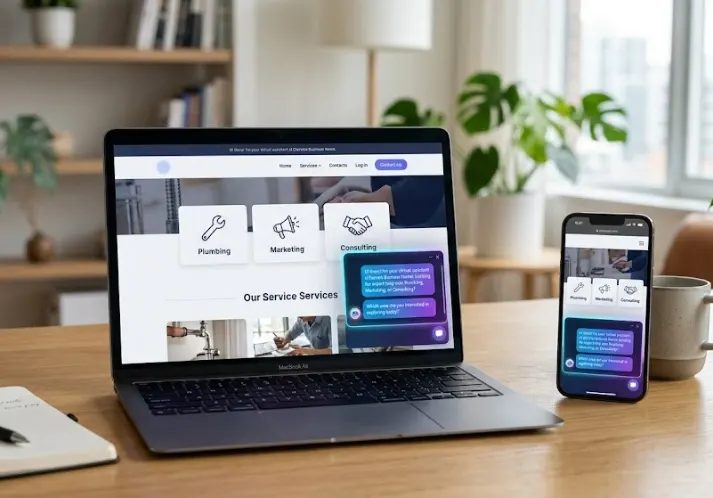
- Get a response process in place that reaches new enquiries within minutes, not days. This is where AI-driven follow-up and lead scoring earn their keep; a chatbot or automated first response can hold a lead’s attention long enough for a human to take over properly. Our AI automation work exists mostly to close this exact gap.
- Review the site every quarter, not every three years.
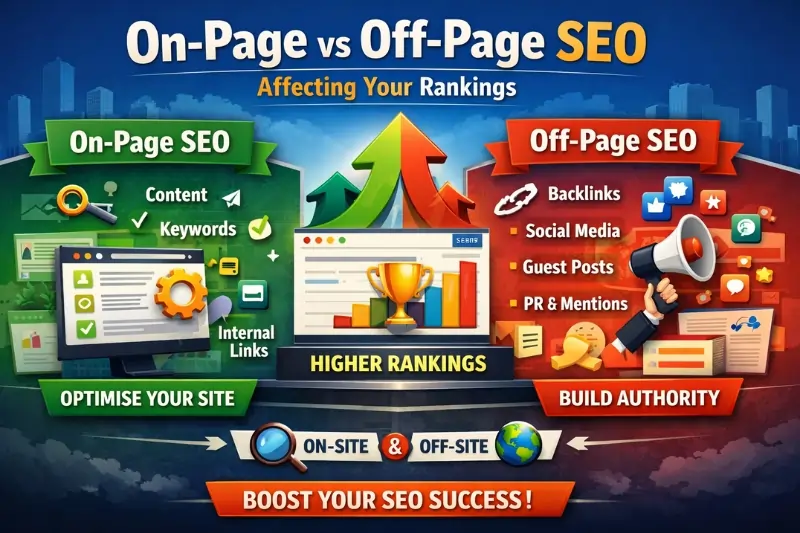
If you’re doing SEO and web work in isolation, you’ll keep hitting this same wall. A site can rank and still not convert, and a beautiful site can convert nobody because no one finds it. The two need to be built together, which is the whole idea behind pairing web development with a proper SEO strategy instead of treating them as separate line items.
Frequently Asked Questions
Why is my website getting traffic but no leads?
Usually a mismatch between what people are searching for and what your pages are built to do. Informational traffic doesn’t convert like commercial-intent traffic does – check which keywords are actually bringing people in before assuming the site itself is broken.
Does a website redesign actually increase leads?
Sometimes, but only if the redesign fixes structure – clearer CTAs, shorter forms, better mobile usability – and not just visuals. A redesign that only changes the look, with the same navigation and the same forms, tends to produce the same lead numbers.
How fast should I respond to a new website enquiry?
Within five minutes if you can manage it. Response speed correlates more strongly with conversion than almost any other single factor after the initial form submit, which is why automated first-response tools have become worth the investment for busy teams.