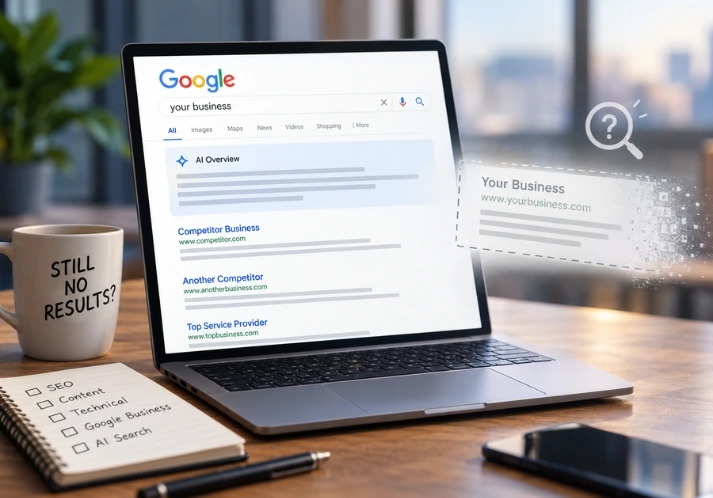
You used to show up. Now you don’t. Same website, same services, same phone number – and somehow the calls have dried up. If you’ve searched your own business name and felt a small jolt of panic when a competitor showed up instead, you’re not imagining things.
Your business is disappearing from Google search results in 2026 because of a combination of AI Overviews absorbing clicks before they ever reach your site, algorithm updates penalising thin or AI-generated content, unresolved technical and indexing errors, and neglected Google Business Profile signals. None of these happen in isolation anymore. They stack.
We’ve spent the last several months pulling businesses out of this exact hole, and the pattern is almost always the same: nobody event triggered the drop. It was five small things, ignored for five months, that added up to one very visible problem.
Google Isn’t Sending You Traffic. It’s Answering For You.
Start here, because this is the one most business owners still don’t fully believe.
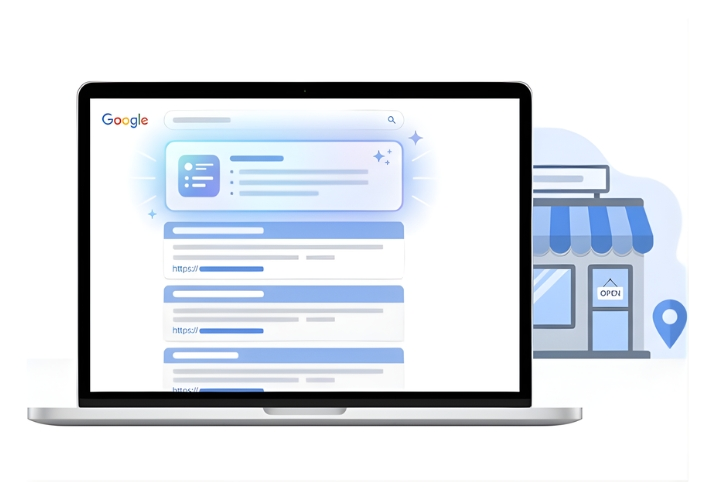
Type a question into Google today and there’s a good chance you get your answer without clicking anything. AI Overviews sit right at the top of the page, summarising content pulled from multiple sites – sometimes including yours, sometimes not – and the person searching never scrolls past it. Position one used to guarantee traffic. It doesn’t anymore. We’ve watched clients hold their exact ranking position month over month while their click-through rate quietly halved.
This isn’t a glitch Google will fix. It’s the direction search is going, and it changes what “ranking well” even means. A page can rank and still lose. That’s the uncomfortable part.
What actually still works: being the source the AI Overview pulls from, rather than the page it buries. That means clear, direct answers near the top of your content (like the one two paragraphs up), specific numbers and named examples instead of vague claims, and content structured so a machine can lift a clean sentence out of it. Vague marketing copy doesn’t get quoted. Specific, well-organised information does.
Your Content Might Be the Reason You Got Hit
Google has run several rounds of updates aimed squarely at content that reads like it was written to rank rather than to help anyone. The 2024–2025 helpful content and core updates set the tone, and 2026’s updates have only sharpened it. Sites full of generic 500-word service pages – the kind where you could swap the city name and nothing else would need to change – are the ones we see drop first and hardest.
Here’s the part that surprises people: it’s often not about AI writing tools specifically. Google’s systems don’t sniff out “AI” the way people assume. What gets penalised is the pattern that both lazy AI use and lazy human copywriting produce – content with no first-hand detail, no opinion, no evidence anyone involved actually knows the topic. We had a client, a family-run electrical business, whose “About Us” page was three sentences and a stock photo of a toolbelt. Rewriting it with the owner’s actual licence number, the suburbs they’d worked in for two decades, and a photo from an actual job did more for that page’s recovery than any technical fix we made that quarter.
If your blog reads like it could belong to any business in any city, that’s not a style problem. That’s the thing actively working against you.
Technical Problems Are Quietly Taking Pages Out of the Index
Not every drop is about content quality. Sometimes Google simply can’t see the page anymore, or has decided it’s not worth keeping in the index.
A few culprits we run into constantly:
- Crawl and indexing errors: A site migration, a botched redirect, or a robots.txt file edited by a well-meaning developer can quietly deindex whole sections of a site. Check Google Search Console’s Page Indexing report – if “Crawled, currently not indexed” is climbing, that’s your early warning.
- Core Web Vitals and page speed: Slow, layout-shifting pages don’t just annoy visitors. They erode the quality signals Google uses to decide whether a page deserves a spot.
- Duplicate or thin URLs from CMS quirks: Tag pages, filtered product URLs, and auto-generated category pages can flood your site with near-identical content that dilutes everything else.
- JavaScript rendering issues: If your key content only loads after heavy client-side scripts run, some of it may never get indexed at all.
Run a crawl of your own site once a quarter. It’s tedious. It’s also the fastest way to catch a problem before it costs you three months of traffic.
Your Google Business Profile Might Be the Weak Link
For local businesses, this is where the disappearing act often actually starts – not on the website at all.
Google has become far stricter about Business Profile verification and category accuracy. We’ve seen profiles suspended over mismatched NAP data (name, address, phone) between the website and directory listings, over category selections that no longer match the services offered, and over a rush of low-quality reviews that trips a spam filter. One suspended profile can wipe a business out of the local map pack entirely, and most owners don’t notice until a customer mentions they “couldn’t find you.”
Go check yours right now: confirm your primary category is accurate, that your address matches exactly across your website, Facebook page, and any directories, and that you’re responding to reviews – Google reads engagement as a trust signal, and an ignored one-star review sitting there for eight months isn’t helping you.
Getting Found by AI Isn’t Optional Anymore
Search behaviour has split. People still type into Google, but they’re also asking ChatGPT, Perplexity, and Gemini for recommendations directly – and those tools pull from a different, narrower set of signals than classic SEO ever cared about.
Structured data matters more here, not less. Schema markup that clearly states what you do, where you operate, and what makes you credible gives these systems something concrete to cite. So does consistency: if your business is described one way on your homepage, another way on LinkedIn, and a third way on a directory listing, you’re making it harder for any AI system to confidently recommend you. Entities that are well-defined and consistent across the web get cited. Ones that are vague and inconsistent get skipped in favour of a competitor who made the effort.
This is genuinely new territory, and we’ll say plainly: nobody has this fully figured out yet, including us. But the businesses treating AI visibility as a real channel – not an afterthought – are the ones showing up when someone asks an AI assistant “who’s a good [service] near me.”
What to Actually Do About It
Skip the 90-day audit deck for a minute. Here’s the order we’d work through this in:
- Check Search Console first: Look at the Coverage and Performance reports for the last six months. A sudden cliff points to a technical or algorithmic hit. A slow decline usually points to content or competitive erosion.
- Verify your Google Business Profile is live, accurate, and unsuspended: This takes ten minutes and rules out (or confirms) one of the biggest local causes.
- Read your five worst-performing pages out loud: If they sound like they were written for search engines instead of people, that’s your content problem, found.
- Run a crawl for indexing and speed issues: Tools like Screaming Frog or Search Console’s own reports will surface most of it.
- Add real structured data and consistent business information: Across your site, GBP and directories.
Most businesses find the cause is two or three of these stacked together, not one dramatic villain. That’s actually good news – it means the fix is a checklist, not a mystery.
Frequently Asked Questions
Why did my business drop out of Google overnight?
A sudden drop almost always points to something technical or structural: a botched site migration, an accidental robots.txt block, a Google Business Profile suspension, or a manual action. Check Search Console’s Manual Actions report and your indexing coverage before assuming it’s a content or ranking algorithm issue.
Can AI Overviews really reduce my traffic even if I still rank #1?
Yes. Ranking position and click-through rate have become separate problems. When an AI Overview answers the query directly, even the top organic result can see a significant drop in clicks, because a portion of searchers never scroll down to it.
How long does it take to recover lost Google visibility?
It depends on the cause. Technical fixes (redirects, indexing, speed) can show movement within two to four weeks. Content and authority issues usually take three to six months, since Google needs to re-crawl, re-evaluate, and rebuild trust in the site over time.
The Bottom Line
Visibility in 2026 isn’t lost to one algorithm update anymore. It’s lost in layers – a slow content problem, a technical issue nobody noticed, a Business Profile left on autopilot, and an AI search layer that changed the rules for everyone at once. The businesses still getting found are the ones checking all four, not just chasing the last update they read about on a marketing blog.
If you want a second set of eyes on where you’re actually losing ground, that’s the exact audit we run at OptiRank for businesses across Australia. We’d rather show you the real cause than sell you a generic package.