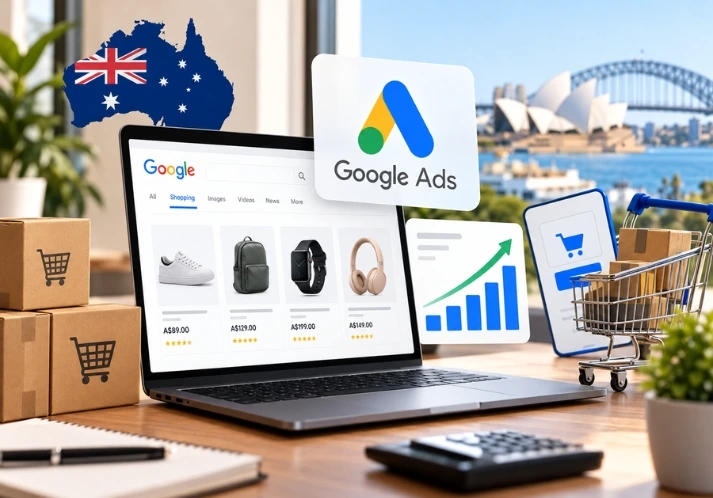
If you manage Google Search campaigns in Australia – whether you’re running a local trade business in Melbourne or scaling an eCommerce store nationally – Google AI Max is something you need to understand right now.
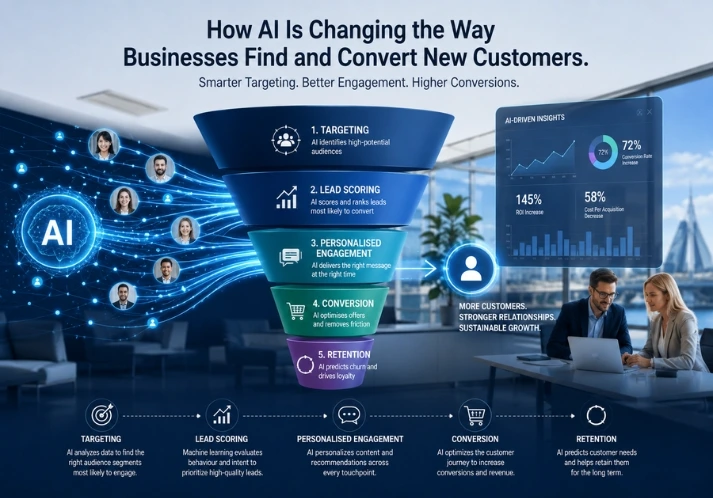
Google AI Max is an automated, native AI suite embedded directly within Google Search campaigns that dynamically expands keyword reach, auto-generates ad assets, and optimizes landing page routing in real-time.
It is not a standalone campaign type, nor does it completely replace the core settings of your existing Search campaigns. Instead, it acts as an intelligent algorithmic layer running inside them. This guide covers exactly how Google AI Max functions, how it changes live ad delivery, and how Australian advertisers can optimize for it in 2026.
What Is Google AI Max?
Google AI Max for Search campaigns is a suite of AI-powered features that Google adds to your existing Search campaigns. It was introduced in 2025 and has since become the fastest-growing AI-powered Search ads product Google has ever launched.
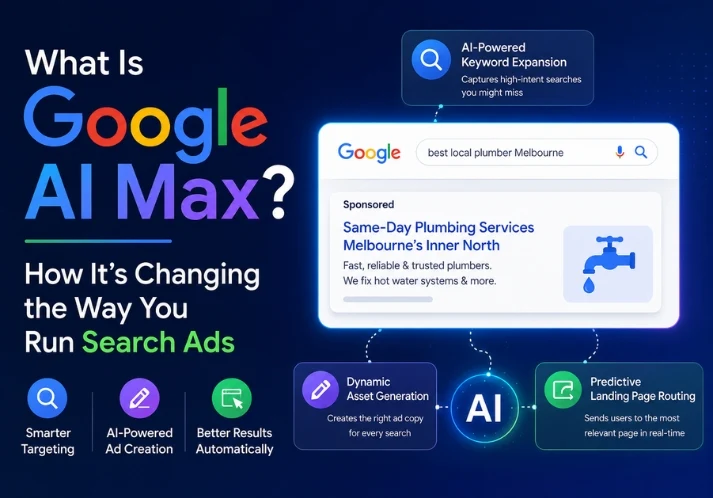
Think of it as an automation add-on – not a separate product, but a set of AI-driven capabilities that run inside your current campaigns when enabled. The three main things it does:
| Core AI Max Feature | Technical Functionality | Performance Impact (2026 Metrics) |
| Semantic Keyword Expansion | Uses contextual match embeddings instead of strict phrase/exact match syntaxes. | Broadens campaign reach to high-intent queries, resulting in an average 14% reduction in Cost Per Acquisition (CPA). |
| Dynamic Asset Generation | Automatically extracts, mixes, and deploys ad headlines and descriptions based on real-time user search context. | Maximizes Ad Strength scores automatically and increases click-through rates (CTR) by delivering hyper-personalized ad copy. |
| Predictive Landing Page Routing | Analyzes the user’s explicit intent and dynamically sends traffic to the most relevant internal page using final URL expansion. | Dramatically reduces landing page bounce rates and fixes user friction caused by static, mismatched destination URLs. |
Why Google Released It
Search behaviour has shifted. People aren’t typing “plumber Melbourne” anymore – they’re typing “who fixes hot water systems same day in Melbourne’s inner north.” Conversational, long-form queries have become the norm, and traditional keyword lists were never designed to capture all of them.
Google built AI Max to help advertisers capture what it calls the “expanding Search universe” – the long-tail, unpredictable queries that your keyword list will always miss. The core promise is more reach, more relevant ads, and less manual work.
In internal Google data from 2026 (published on their Ads blog), advertisers using AI Max saw meaningful gains in conversions for non-Retail campaign types. The numbers sound good. But there’s context behind them that matters for how you interpret those claims.
What’s New in 2026: AI Brief and Shopping Expansion
When Google AI Max turned one year old in April 2026, Google announced several updates that genuinely changed the tool’s scope.
AI Brief is the most interesting addition. Powered by Gemini, it lets advertisers guide the AI using plain language rather than rigid settings. You can tell AI Brief things like “never mention pricing,” “focus on customers who are health-conscious,” or “prioritise searches related to commercial fit-outs, not residential.” These aren’t hard rules – they’re guidelines the AI uses to steer its targeting and messaging decisions.
For Australian businesses with specific brand tone requirements or industries that need careful language (think financial services, healthcare, or trade services), AI Brief gives you a much-needed layer of control that the earlier version of AI Max lacked.
Shopping campaign expansion: AI Max is no longer limited to Search. Google now offers AI Max for Shopping campaigns, where it uses your Merchant Centre product data to create dynamic Shopping ads that respond to conversational queries. For Australian eCommerce businesses, this matters – your product listings can now surface for complex buying-intent queries that standard Shopping campaigns wouldn’t catch.
Travel formats: For travel advertisers, AI Max now consolidates feed-based formats and search into a single campaign view, simplifying what was previously a fragmented setup across multiple campaign types.
Dynamic Search Ads Are Being Upgraded – Whether You Want It or Not
This is the part that’s caught some Australian advertisers off guard.
Starting in September 2026, Google will automatically upgrade Dynamic Search Ads (DSA) campaigns to AI Max. DSAs, which used your website to generate ad targets and headlines automatically, are being deprecated as a standalone format. AI Max is their replacement.
If you’re running DSA campaigns right now, they will be migrated. You don’t need to do anything to trigger this – it will happen by default. The performance logic, targeting capabilities, and reporting will all shift to the AI Max framework.
This isn’t necessarily bad news. AI Max is a more capable system than traditional DSA. But it does mean your current reporting benchmarks, asset performance, and keyword exclusion setups all need to be reviewed before the upgrade happens.
What Australian Advertisers Need to Think About
Here’s the practical reality of running Google AI Max in the Australian market.
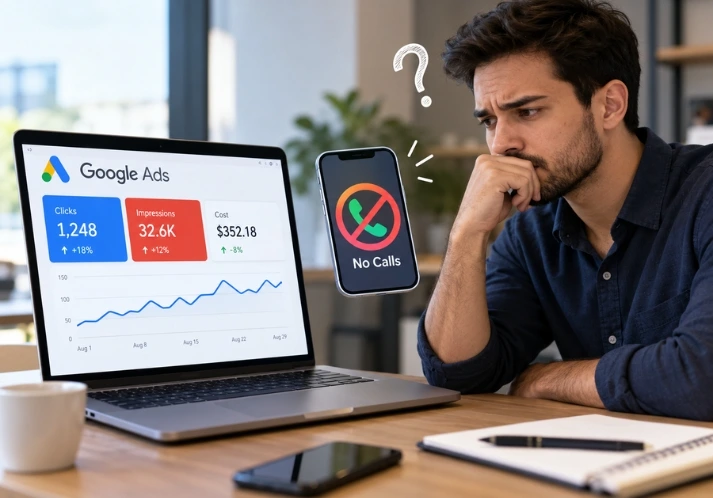
Your conversion tracking has to be solid: AI Max makes bidding and targeting decisions based on conversion signals. If your tracking is incomplete – missing phone call conversions, not tracking lead form submissions, or counting view-through conversions incorrectly – the AI is making decisions with bad data. This is the single most important prerequisite before enabling AI Max in any campaign.
Watch your search term reports: Because AI Max expands matching beyond your keywords, you’ll start seeing spend on queries you didn’t directly target. Some of these will be great. Others won’t be. You need to review search term reports regularly and use term exclusions to cut what’s irrelevant.
Negative keywords still matter – maybe more than before: AI Max’s expanded matching makes robust negative keyword lists more important, not less. Without them, budget can leak into broad, low-intent queries quickly.
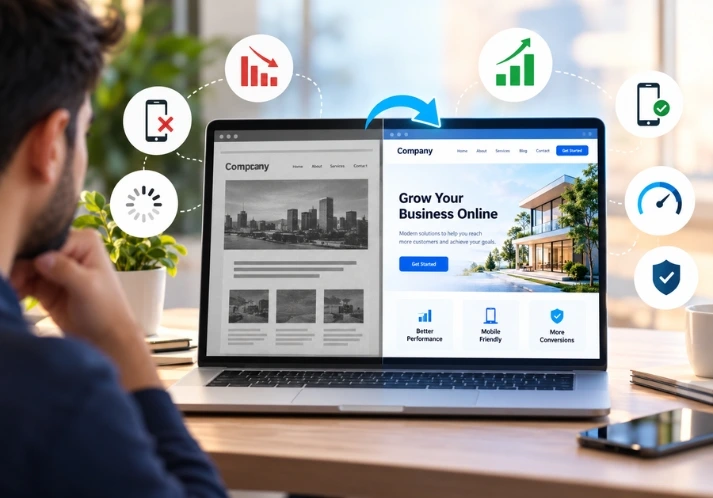
URL expansion needs active management: If AI Max is redirecting users to different pages than the ones you specified, you need to check whether those pages are actually better for the query – and whether they meet any legal or compliance requirements. For Australian industries with mandatory disclaimers (financial services, health, legal), this is non-negotiable to monitor.
Campaign structure affects performance: AI Max running across multiple overlapping campaigns in the same account can create internal competition – your campaigns bidding against each other for the same queries. Before turning on AI Max, review your campaign architecture to make sure there are clear boundaries between what each campaign is meant to capture.
Is Google AI Max Worth Enabling?
Honestly, it depends on where your account is.
If you have clean conversion tracking, a well-structured campaign setup, and someone actively monitoring search terms and asset performance, AI Max can genuinely improve your reach and reduce time spent on manual keyword research. The expanded matching works, and the asset generation – while imperfect – can surface combinations you wouldn’t have tested on your own.
If your tracking is patchy, your campaigns overlap, or you’re not checking in on performance weekly, enabling AI Max is likely to increase spend without a clear return. The AI optimises for signals you give it. If those signals are noisy, the output will be too.
For most Australian small-to-medium businesses – trade services, professional services, local retail – a phased approach makes sense. Enable AI Max on one campaign with your tightest tracking and clearest conversion goals, review it for 30 days, then decide whether to expand it across your account.
What Comes Next for Search Ads in Australia
Google AI Max is part of a bigger shift in how search advertising works. Google is integrating AI Overviews and AI Mode into search results, meaning ads now appear inside conversational AI answers – not just below a traditional search bar.
This changes how ad copy needs to work. Brief, punchy taglines matter less. Clear, specific, benefit-driven messaging that answers actual questions matters more. It’s a shift Australian advertisers should be preparing for now, not after Google’s defaults have already changed their campaigns.
The advertisers who will do well with AI Max – and with the broader AI-driven Search landscape – are the ones who treat it as a tool they direct, not one they hand off to. Clean data, clear campaign boundaries, regular performance reviews, and specific guidance through tools like AI Brief will separate accounts that grow from ones that spend.
Get Your Google Ads Ready for AI Max
At Optirank, we work with Australian businesses every day on exactly this kind of setup – auditing conversion tracking, restructuring campaigns, and making sure AI features are working with your strategy rather than running loose across your account.
If you want a clear picture of how your Google Ads account stands up to the AI Max changes, book a free consultation or request a free audit. We’ll tell you exactly what needs to be fixed before September.
Frequently Asked Questions About Google AI Max
Is Google AI Max a separate campaign type?
No. Google AI Max is an optimization suite that integrates directly into your existing Google Search campaigns. It operates as an automation layer to scale asset matching and targeting without requiring a separate budget split.
How does AI Max handle budget allocation?
AI Max works within your established campaign budget. It uses real-time predictive modeling to shift impressions toward the asset combinations and landing pages that show the highest probability of conversion.
Can I opt out of specific AI Max features?
Yes, advertisers retain control over brand exclusions and can turn off final URL expansion if they prefer to route traffic to a single, static landing page.