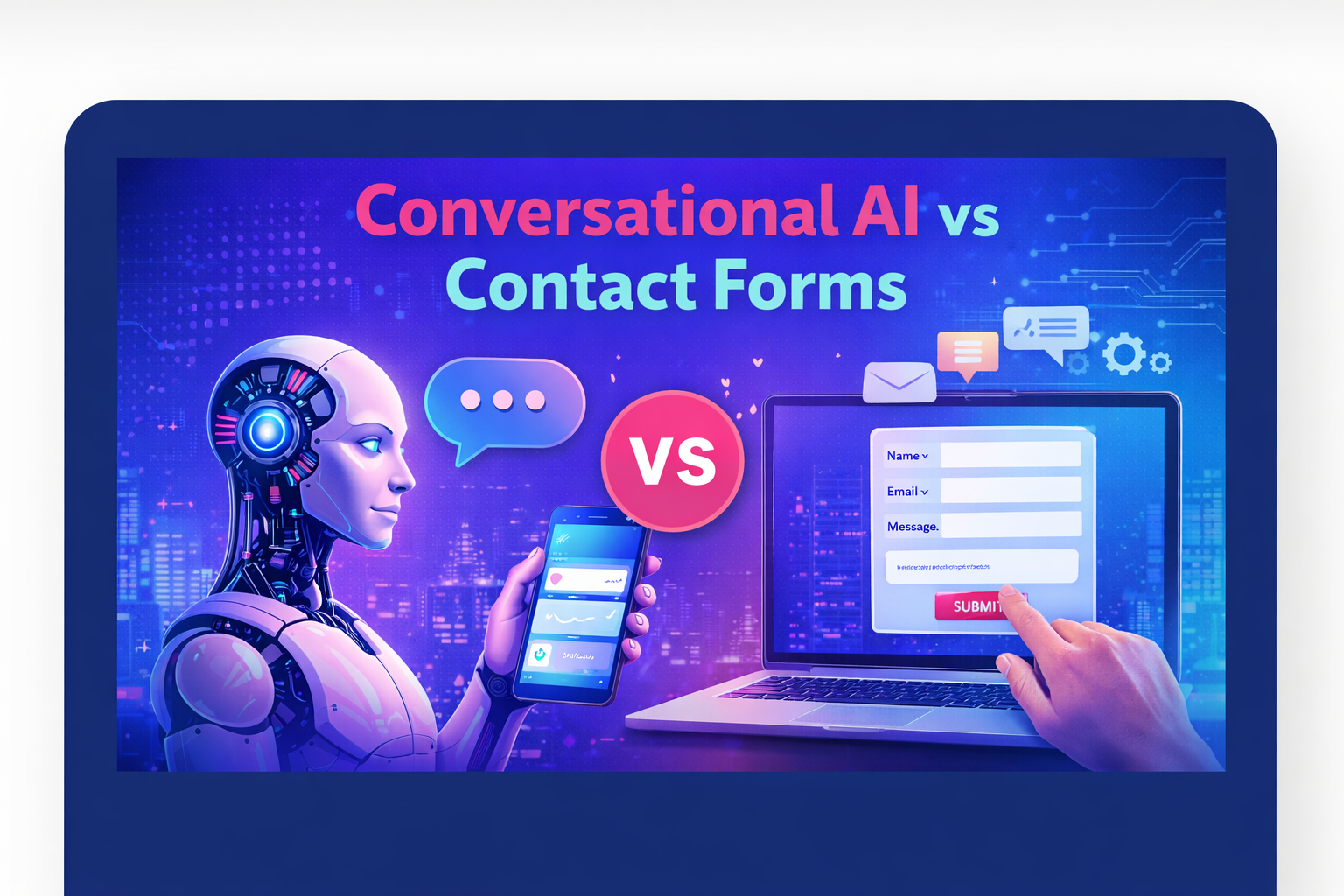

Most business websites still run on a formula from 2010: a “Contact Us” page, a handful of fields, and a “Submit” button that sends an email nobody checks until the next morning. It’s familiar. It’s also quietly costing businesses enquiries every single day.
We’ve watched this play out with our own clients at Optirank. A tradie’s site with a contact form buried three clicks deep. A finance broker whose form submissions sat in a shared inbox for six hours before anyone replied. A property services business losing after-hours visitors who had a question at 9 pm and no way to get an answer. In every case, the fix wasn’t a prettier form – it was replacing the form with a conversation.
This isn’t a fringe trend. It’s becoming the default for businesses that treat their website as a lead generation channel rather than a digital brochure.
The Contact Form Problem, in Numbers
Contact forms aren’t broken because they’re ugly. They’re broken because of how people actually behave online.
Average form conversion rates sit around 1–3% across most industries, according to widely cited HubSpot and WordStream benchmarking data. That means out of every 100 people who land on a contact page, only one to three ever finish filling it out. The rest bounce, get distracted, or decide the question wasn’t worth the effort.
Form abandonment is the bigger culprit. Independent research on form completion behaviour puts abandonment rates as high as two-thirds of everyone who starts typing. A visitor gets three fields in, hits a phone number field they don’t want to give out yet, and closes the tab.
Then there’s the response gap. A well-known Harvard Business Review study of over 2,000 companies found that businesses responding to a lead within the first hour were roughly seven times more likely to qualify that lead than those who waited even slightly longer. Most contact forms don’t come close to that. The submission sits in an inbox, a spam filter, or a “we’ll get to it Monday” pile, and by the time someone replies, the visitor has already requested a quote from two competitors.
None of this is a form design flaw you can fix with a better button colour. It’s structural. A form asks someone to do work now for a payoff later, with no proof anyone’s listening.
What Changes When You Swap the Form for a Chatbot
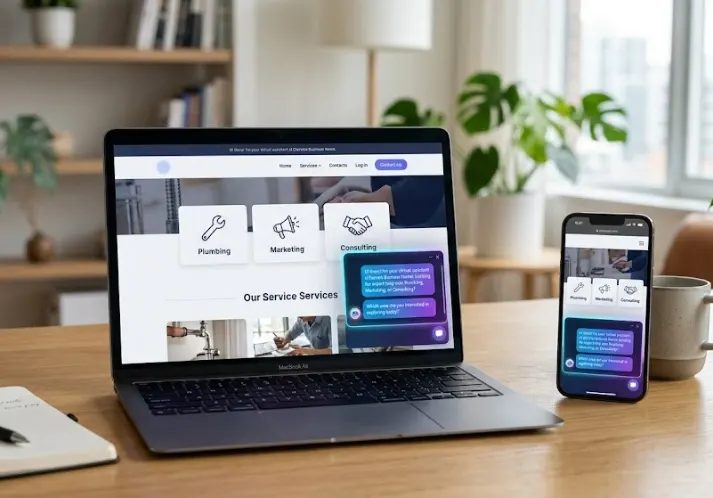
An AI chatbot flips the exchange. Instead of “fill this in and wait,” it’s “ask your question and get an answer right now.”
That shift shows up directly in the numbers. Multiple 2026 industry reports – from chatbot vendors and independent marketing researchers alike – put chatbot-led conversion somewhere between 10% and 30%, depending on the industry and how well the bot is set up. Even the conservative end of that range is three to five times what a static form typically pulls in.
A few reasons this holds up in practice:
It removes the waiting: The visitor doesn’t submit and hope. They get a response in seconds, at 11 pm on a Sunday just as easily as 11 am on a Tuesday. For service businesses – tradies, agencies, clinics, brokers – a huge share of website traffic happens outside business hours, and a form is useless to that traffic until someone’s back at their desk.
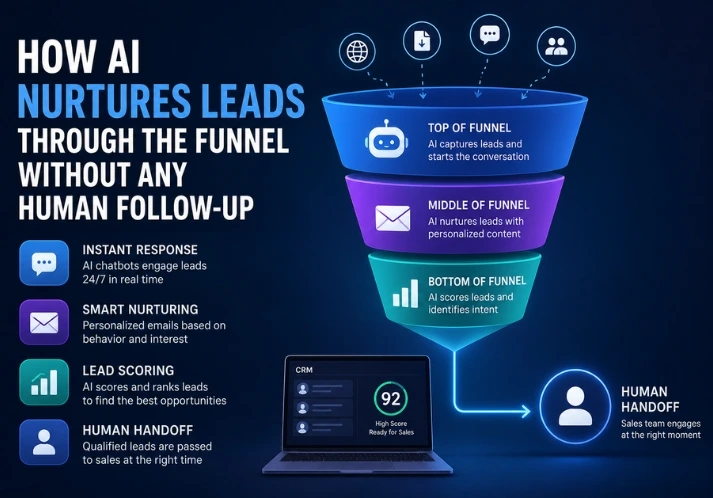
It qualifies while it engages: A decent chatbot doesn’t just say “thanks, someone will be in touch.” It asks the next logical question – budget range, timeline, location, what they actually need – the way a good salesperson would on a phone call. By the time a human picks up the conversation, there’s already context instead of a blank “Hi, interested in your services” message.
It lowers the commitment required to start: Typing “do you service Werribee?” into a chat box feels like nothing. Filling out name, email, phone, and a message box to ask the same question feels like a small chore. People will do the first thing far more readily than the second.
It captures the moment of intent: Someone reading a service page and getting curious is a warmer lead right then than the same person twenty minutes later, after they’ve closed six tabs and forgotten why they were interested. Chat sits on the page, not behind a link, so it catches that moment instead of losing it.
Forms Aren’t Dead – They Still Have a Job
It’s worth being straight about this: contact forms aren’t obsolete, and a chatbot isn’t a universal replacement.
Forms still make sense for detailed, structured requests – a job application, a formal quote request with specific specs, or anything where you genuinely need clean, structured data rather than a conversation. Some visitors also just don’t want to chat. They know exactly what they want, and a form gets them there faster than a back-and-forth.
The businesses getting the best results in 2026 usually run both. A chatbot handles the front door – answering questions, qualifying interest, catching the casual browser who wasn’t going to fill out a form anyway. A form (or a booking link the bot hands off to) handles anyone ready to give full details. They’re not competing tools; the chatbot is what happens before someone’s ready for the form.
Where This Actually Moves the Needle for Enquiries
The businesses that see the biggest jump aren’t necessarily the ones with the fanciest chatbot – they’re the ones that put it where the friction was worst.
A property maintenance business, for example, gets a lot of traffic from people comparing quotes at odd hours – evenings, weekends, whenever the job’s on their mind. A chatbot that can answer “do you cover [suburb]?” and “roughly what does this cost?” on the spot, and then offer to book a call, captures enquiries a next-morning email reply would have lost entirely.
A finance or mortgage broker deals with visitors who have a specific, slightly sensitive question – “can I refinance with this credit history?” – that they’re reluctant to type into an open-ended form message box. A guided chat flow that asks a few qualifying questions first feels less exposed than writing an essay to a stranger.
In both cases, the underlying pattern is the same: the chatbot isn’t generating new demand out of nowhere. It’s catching demand that already existed on the page and would otherwise have walked away.
Getting This Right Without Overcomplicating It
A chatbot that just repeats FAQ answers isn’t much better than a static page – it’s a form with a typing animation. The businesses that get real lift from this shift usually get a few things right:
- The bot is grounded in real business content – actual services, pricing ranges, service areas, and policies – not generic scripted answers that fall apart under a specific question.
- There’s a clear handoff to a human – anything the bot can’t handle routes to a real person confidently, with the conversation history attached, rather than leaving the visitor stuck.
- It’s placed where the friction already is – service pages, pricing pages, the contact page itself – not just buried in a corner widget nobody notices.
- Leads get scored and routed – not just dumped into an inbox the same way form submissions used to be. The whole point is speed; a chatbot that captures a lead and then sits in a queue for six hours has solved nothing.
This is also where a lot of DIY chatbot setups fall short – the bot goes live, sounds reasonable for the first few questions, and then gives a wrong answer on pricing or availability that costs more trust than the old form ever did. Getting the qualification flow and the CRM handoff right is usually the difference between a chatbot that quietly generates leads and one that just looks good in a demo.
Frequently Asked Questions
Do AI chatbots really convert better than contact forms?
Yes, in most published 2026 industry data. Static contact forms typically convert around 1–3% of visitors, while a properly configured AI chatbot converts somewhere in the 10–30% range, largely because it removes waiting time and engages visitors at the moment they’re actually interested.
Should I remove my contact form completely?
No. Keep it for visitors who want to submit detailed, structured requests, and use the chatbot to handle everything upstream of that – quick questions, qualification, and catching visitors who wouldn’t have filled out a form at all.
Is a chatbot expensive to set up?
It varies with complexity, but the cost is usually far lower than the value of the enquiries a slow, form-only setup is losing – especially for businesses that get meaningful after-hours traffic.
What’s the biggest mistake businesses make with chatbots?
Launching a generic, scripted bot that can’t answer specific questions about the actual business, or capturing leads through chat and then still routing them into a slow manual follow-up process – which cancels out the speed advantage entirely.
The Real Shift
The core idea here isn’t really about chatbots versus forms. It’s about response time and friction. A form asks someone to do work and wait. A chatbot removes both. For businesses relying on their website to generate genuine enquiries – not just traffic – that difference is often the gap between a lead that converts and one that quietly goes to a competitor who answered first.
If your site is still running on a static contact form and you’re not sure whether an AI chatbot would actually pay for itself, that’s worth working through properly rather than guessing – get in touch with our team and we’ll look at where your site is losing enquiries.