What is a landing page – and why does so much of your marketing budget depend on getting the answer right?
If you’ve ever run a Google Ad, sent an email campaign, or promoted a service on social media, you’ve probably been told you need a landing page. But a lot of business owners still treat it the same as any other page on their website. That’s a costly mix-up.
A landing page and a website are two very different tools. One is built for exploration. The other is built for one thing only – getting a visitor to take a specific action. Knowing which to use, and when, can change how well your digital marketing actually performs.
What Is a Landing Page, Exactly?
A landing page is a standalone web page built around a single goal. Someone clicks a link – from an ad, an email, a social post – and they “land” on this page. Everything on it, the headline, the copy, the images, the button – points toward one action.
That action might be:
- Filling out a contact form
- Booking a free consultation
- Downloading a guide or checklist
- Signing up for a webinar
- Buying a specific product
There’s no navigation menu pulling visitors elsewhere. No blog links. No “About Us” tab. Just the offer and a clear path to take it.
This focus is intentional. The fewer decisions a visitor has to make, the more likely they are to follow through on the one you want.
How a Website Works (and Why It’s Different)
A website is your full digital presence. It has multiple pages covering everything about your business – who you are, what you offer, your past work, your blog, and your contact details.
Its job is to inform, build trust, and give visitors room to explore at their own pace.
Someone might land on your homepage, read a service page, check a few blog posts, and then reach out. That journey takes time, and that’s fine – websites are built for it.
A website answers questions like:
- What does this business do?
- Can I trust them?
- Do they work with businesses like mine?
- What have their past clients said?
A landing page doesn’t try to answer all of that. It focuses on one offer, for one audience, at one moment in their decision.
Landing Page vs Website: The Key Differences
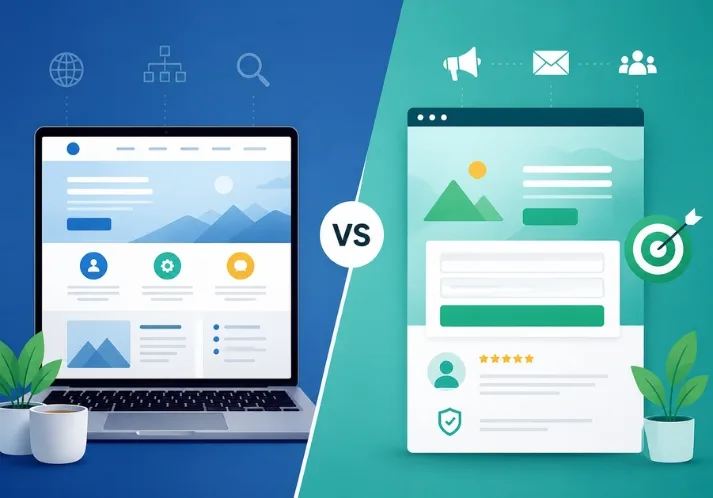
Here’s where most people get confused. A landing page can live on your website – but that doesn’t make it the same thing. The purpose, structure, and behaviour are completely different.
Goal
A website serves many goals – brand awareness, SEO traffic, customer education, support. A landing page has one goal. One CTA. One decision for the visitor to make.
Navigation
Websites have full navigation menus because you want people to explore. Landing pages typically remove navigation entirely. Every extra link is a potential exit. Fewer exits mean more conversions.
Content depth
A website goes in-depth across many topics. A landing page keeps it lean – just enough information to convince someone to act, nothing more.
Traffic source
Websites attract organic traffic from search engines over time. Landing pages are usually the destination for paid ads, email campaigns, or social media clicks, where the visitor already has some intent.
SEO role
Websites are strong SEO assets. They have multiple pages, internal linking, content hubs, and the chance to rank for dozens of keywords. Landing pages are usually not the best place to target long-term organic rankings (though it’s possible with the right setup).
Do You Need a Landing Page, a Website, or Both?
Short answer – both. But when you use each depends on what you’re trying to do.
Use a landing page when:
- You’re running paid ads and need to match the ad message to a specific page
- You have a time-sensitive promotion or seasonal offer
- You’re launching a product and want early sign-ups
- You’re running a lead generation campaign with a specific audience in mind
- You want to test an offer before building a full section of your site
Use your website when:
- Someone is in the research phase and wants to understand your business
- You want to rank for organic keywords over the long term
- You need to establish credibility through case studies, reviews, or a blog
- A visitor needs multiple touchpoints before they’ll reach out
In most digital marketing campaigns, both work together. A Google Ad sends traffic to a targeted landing page. That landing page converts the click. The website builds the trust and credibility that made the visitor click in the first place.
Why Landing Pages Convert Better for Campaigns
There’s a reason conversion rate benchmarks from Unbounce consistently show landing pages outperforming generic website pages for campaign traffic.
When someone clicks an ad that says “Get a Free SEO Audit,” they want to land somewhere that talks about – the free SEO audit. Not your homepage. Not your services overview. The exact thing they clicked on.
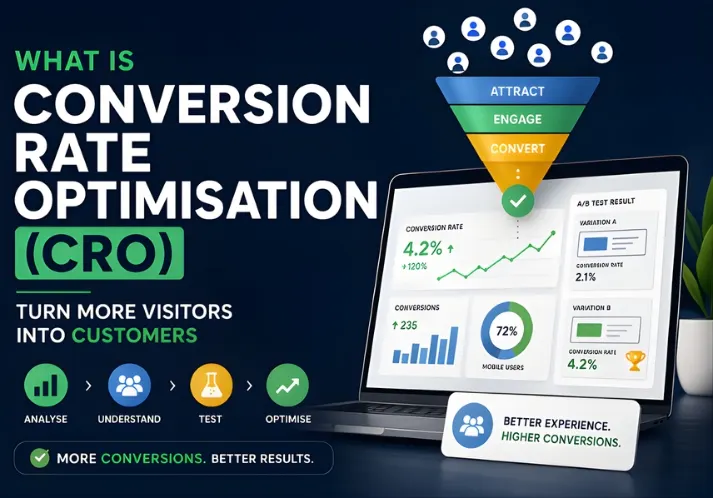
Landing pages remove the friction between the click and the conversion. When the message matches what the visitor expected, and there’s one clear next step, more people take it.
A few things that make landing pages work:
- One clear headline that matches the ad or email they came from
- Social proof – a quick testimonial or a client logo strip builds instant trust
- A benefit-focused CTA – “Get My Free Audit” works better than “Submit”
- Minimal distractions – no sidebar links, no footer menus
- Mobile optimisation – a large portion of campaign traffic comes from phones
Can a Landing Page Replace a Website?
Not really – not for most businesses.
A landing page can work as a temporary presence (think: a pre-launch page or a single-service offer page). But it can’t do what a website does in terms of long-term SEO, brand storytelling, or giving visitors the depth of information they need before trusting a business with their money.
Think of it this way. Your website is your office. It’s where you live online. A landing page is more like a flyer you hand out at an event – specific, targeted, and designed to get one response.
Some business owners, especially in the early stages, try to run a campaign with only their homepage as the destination. The problem is that a homepage isn’t built to convert campaign traffic. It’s built to inform. Visitors arrive, get distracted by the navigation, wander around, and leave without taking any action.
The Landing Page and Homepage Are Not the Same Thing
This is worth clearing up on its own.
Your homepage is the front door of your website. It gives an overview of your business, points to different sections, and speaks to a broad audience.
A landing page is purpose-built for a specific audience responding to a specific message. It’s narrow on purpose. The homepage tries to serve everyone. A landing page serves one person – the one who just clicked that particular ad or email.
Mixing these up is one of the most common mistakes in paid advertising. Sending paid traffic to a homepage wastes your ad spend, because the page isn’t designed to finish the job your ad started.
Quick Reference: Landing Page vs Website
| Feature | Landing Page | Website |
| Purpose | One specific conversion | Broad brand presence |
| Navigation | Removed or minimal | Full menu |
| Pages | Single page | Multiple pages |
| Traffic source | Paid ads, email, social | Organic search, referral, direct |
| SEO value | Limited | Strong |
| Content | Focused on one offer | Wide-ranging |
| Best for | Campaigns and lead gen | Long-term digital presence |
External Resource
For a deeper look at how conversion-focused design affects landing page performance, Unbounce’s Conversion Benchmark Report tracks average conversion rates across industries – worth bookmarking if you’re planning a campaign.
Frequently Asked Questions
Is a landing page the same as a homepage?
No. A homepage is the main entry point of your full website and is designed to give an overview of your entire business. A landing page is a single, focused page built around one specific action – like signing up, booking, or buying. They serve different purposes and are used at different stages of a customer’s journey.
Can a landing page hurt my SEO?
A standalone landing page with thin content and no internal links won’t do much for your organic rankings – but it won’t necessarily hurt your broader site either. If SEO traffic is your goal, a well-structured website with a content strategy is a better investment. Landing pages work best alongside paid or email-driven traffic.
How long should a landing page be?
It depends on how complex the offer is. A simple lead magnet or free consultation might need just a few sections – headline, brief explanation, social proof, and a form. A high-ticket service or product might need more content to overcome hesitation. The rule is: as long as it needs to be, no longer.
Do I need a landing page if I already have a website?
Yes, if you’re running paid campaigns. Sending ad traffic to your general website is usually less effective than sending it to a page that matches exactly what the ad promised. A landing page keeps the visitor focused and improves your chance of converting that click into a lead.
What’s the difference between a landing page and a sales page?
A landing page is a broader term – it covers any page designed to capture a specific action (including lead generation). A sales page is a type of landing page specifically aimed at getting someone to make a purchase. Sales pages tend to be longer because they need to handle more objections before asking for the sale.
How many landing pages should my business have?
As many as you have campaigns or distinct offers. Each paid ad group or email campaign should ideally point to its own landing page with a message that matches. Businesses with multiple services often have separate landing pages for each – so the right visitor sees the right message every time.
Looking to build landing pages that actually convert, or need help getting your website ranking in Melbourne? Optirank specialises in SEO, web development, and digital strategies designed to turn traffic into real leads.