What makes it different from “machine learning” is that most will just shrug or use the two words like they’re the same thing. They’re not, and the mix-up isn’t harmless – we see clients buy “AI-powered” tools every month that turn out to be a handful of if-then rules with a fancy dashboard.
This comes up almost every week in our client calls at OptiRank, usually right before someone asks us to recommend an “AI tool” for their business. So here’s the machine learning vs AI question answered properly, without the textbook language.
What Artificial Intelligence Actually Means
AI is the big umbrella term. It covers any system built to do something that would normally need a human brain – recognising a face in a photo, holding a conversation, deciding the fastest delivery route, beating a grandmaster at chess.
Here’s the part most explainers skip: AI doesn’t require learning at all. A program can be 100% AI and never adapt a single line of its own logic. Deep Blue, the IBM system that beat Garry Kasparov in 1997, didn’t learn chess the way a person does. It searched through millions of possible moves using rules programmers wrote by hand. No training data, no learning over time – just brute-force calculation dressed up as strategy. It was AI. It was not machine learning.
That distinction matters more than people realise, because it means “artificial intelligence” is really just a goal – make the machine act smart – and there are several different roads to get there. Machine learning happens to be the road almost everyone is talking about right now.
What Machine Learning Actually Means
Machine learning is one specific way of building AI. Instead of a developer writing out every rule by hand, you feed the system a pile of examples and let it work out the pattern on its own.
Take spam filtering. The old-school approach was a human writing rules: block anything with “FREE MONEY” in the subject line, flag emails from unknown senders, that sort of thing. It worked until spammers learned to dodge the rules. The machine learning approach is different – you show the system thousands of emails already labelled “spam” or “not spam,” and it figures out on its own which words, senders, and patterns tend to show up in junk mail. Nobody wrote that logic. The system extracted it from data.
That’s the core trait of machine learning: it needs data to function, and the more relevant data it sees, the better it tends to get. No data, no learning, no machine learning.
So Is Machine Learning Just “AI With Data”?
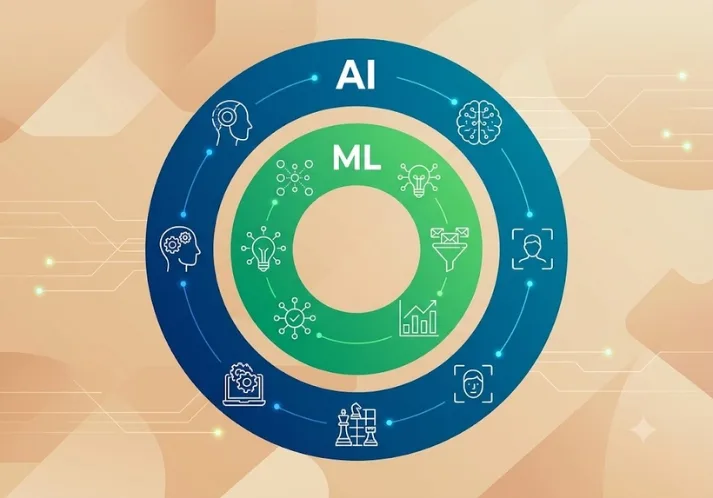
Roughly, yes – and the easiest way to picture it is as nested circles rather than two separate boxes. AI is the outer circle: any technique aimed at making a machine behave intelligently. Machine learning sits inside it as one method for getting there. Deep learning, the neural-network-based approach behind tools like ChatGPT and image generators, sits inside machine learning as a more specific technique still.
Here’s the relationship laid out plainly:
| Artificial Intelligence | Machine Learning | |
| What it is | The broad goal of making machines act intelligently | One method for reaching that goal |
| Needs data to work? | Not necessarily | Yes, almost always |
| Can it be rule-based? | Yes | No – it learns patterns instead of following fixed rules |
| Example | A rule-based chess engine, a basic chatbot with scripted replies | A spam filter, Netflix’s recommendation engine, a fraud-detection system |
| Relationship | The category | A subset of the category |
Every machine learning system is AI. Not every AI system uses machine learning. That one line answers most of the confusion people have.
Examples You’re Already Using Without Noticing
This stuff stopped being theoretical years ago – most people interact with both several times a day without realising which is which.
Netflix suggesting your next show, Spotify building your Discover Weekly playlist, your bank flagging a suspicious transaction – all machine learning. They’re built on historical data and get sharper as more of it rolls in.
A chatbot on a small business website that only answers three pre-written FAQ questions and says “I don’t understand” to anything else – that’s AI, but it’s not machine learning. It’s a flowchart wearing a friendly avatar.
Voice assistants like Siri or Google Assistant blur the line on purpose. The part that turns your voice into text uses machine learning (specifically deep learning). The part that decides what to actually do with “set a timer for ten minutes” is closer to scripted logic layered on top. One product, two different techniques stacked together.
And the self-checkout machine scanning your groceries? Not AI at all. It’s matching a barcode to a price in a database – plain old automation with zero “intelligence” involved, despite what the marketing on the box might imply.
Why This Mix-Up Actually Costs Businesses Money
We’ve watched business owners sign contracts for “AI solutions” that were really just rule-based automation with no learning component – not necessarily a bad tool, but not what they paid for or expected. The vendor wasn’t always lying. Sometimes they just used “AI” the way everyone else does, loosely.
The fix is asking one direct question before you buy anything labelled AI: is this system learning from data over time, or is it just running fixed rules someone programmed once? Both can be useful. They are not the same investment, and they don’t solve the same problems.
This is exactly the conversation we have before building anything in our AI automation work – being upfront about which parts genuinely learn from your customer data and which parts are smart but static rule-following. A business chasing personalisation that improves over time needs real machine learning underneath it. A business that just wants faster, more consistent responses to repetitive enquiries can often get there with simpler rule-based AI, for a fraction of the cost.
Where This Matters for SEO and Search Visibility
Google has used machine learning inside its ranking systems for years – RankBrain and the broader neural-matching systems are genuine ML, trained on search behaviour rather than hand-coded by engineers. That’s different again from the generative AI Overviews now appearing in search results, which sit on top of those ranking systems rather than replacing them.
For content owners, the practical takeaway is this: ranking well in classic search and getting cited inside AI-generated answers both reward the same things – clear definitions, direct answers near the top of a section, and structure that’s easy to extract rather than buried in fluff. It’s part of why our AI SEO services focus on writing content that works for both a human skimming the page and an AI system trying to summarise it.
Quick Myths Worth Killing
“All AI learns over time.” No. Plenty of AI runs on fixed rules and behaves the same way on day 1,000 as it did on day one.
“Machine learning and deep learning are the same thing.” Not quite. Deep learning is a specific type of machine learning that uses layered neural networks, generally needs far more data, and tends to be what’s behind the more impressive recent AI tools.
“More data automatically means a smarter system.” Not always. Messy, biased, or irrelevant data can make a machine learning model worse, not better. Quality and relevance matter as much as volume.
Frequently Asked Questions
Is ChatGPT AI or machine learning?
Both, technically. It’s built using machine learning – specifically deep learning – to train a model, and the finished product is a piece of artificial intelligence. The training method is ML; the result is AI.
Can you have AI without machine learning?
Yes. Rule-based expert systems, scripted chatbots, and traditional game AI are all artificial intelligence without any learning component.
Which one should my business actually care about?
It depends on the problem. If you need a system that personalises or improves as it sees more customer data – recommendations, lead scoring, churn prediction – that’s a machine learning problem. If you just need consistent, faster handling of repetitive tasks, rule-based AI or simple automation is often cheaper and just as effective.
Is machine learning the same as AI automation for business?
Not exactly. AI automation can mean either approach, depending on what’s being automated. The label tells you something is automated; it doesn’t tell you whether learning is involved.
The Short Version
Artificial intelligence is the goal. Machine learning is one way – currently the most popular way – of getting there. Every machine learning system counts as AI, but plenty of AI gets built without any machine learning at all. Once that clicks, every “AI-powered” claim you see gets a lot easier to evaluate.
If you’re trying to work out which approach actually fits your business – and which vendors are using “AI” loosely – get in touch with our team for a straight answer before you sign anything.