You’ve probably heard the word “backlink” thrown around in every SEO conversation. But ask most business owners what it actually means – or why it matters – and you’ll get a blank stare.
Fair enough. The SEO world loves jargon.
So let’s cut through it.
What is a Backlink? Let’s Start from Scratch
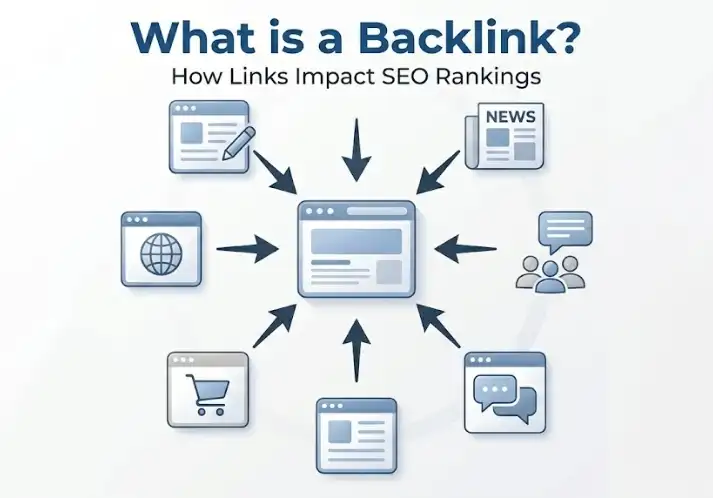
What is a backlink? It’s when another website includes a link that points to a page on your website. That’s it. Nothing more complicated than that.
If a Melbourne real estate blog writes an article and links to your property management company as a reference, that’s a backlink. If a local news site covers a story and mentions your business with a clickable link – that’s a backlink too.
You’ll also hear them called inbound links or incoming links. Same thing, different names.
Now, why does Google care about them? Because a link from another site is essentially that site saying, “Hey, this page is worth reading.” It’s a vote of trust. And when enough trusted websites are pointing at yours, Google takes notice.
The idea goes back to Google’s original algorithm, PageRank – named after Google co-founder Larry Page, not web pages, by the way. The basic theory was: if lots of good websites link to you, your content is probably good too. Twenty-five years later, that logic still holds.
How Google Actually Uses Backlinks
Google doesn’t treat all backlinks the same way. Not even close.
A link from a well-respected Australian news outlet carries far more weight than a link buried on some random overseas blog that hasn’t been updated since 2018. Google looks at where the link is coming from, whether it’s relevant to your topic, and whether it looks natural or forced.
Google’s link evaluation is far more selective now. The strongest links aren’t just high-authority – they’re topically aligned, editorially placed, and naturally earned. ClickRank
Think of it this way. If you’re running an accounting firm in Melbourne and a major financial publication links to one of your articles, that signals to Google you know your stuff. But if fifty unrelated websites suddenly link to you overnight, Google’s going to raise an eyebrow. That looks like manipulation, and their algorithm is very good at spotting it.
Pages with lots of backlinks rank above pages that don’t have as many backlinks. The number-one result in Google has an average of 3.8x more backlinks than positions two through ten. Search Engine Land That stat says a lot.
Dofollow and Nofollow – You Need to Know the Difference
Not every backlink passes the same value to your site. There are two main types, and the difference matters.
DoFollow links are the default. When a website links to yours without any special tag attached, Google follows that link and passes what SEOs call “link equity” – essentially, some of that site’s authority flows to yours. These are the links that move the needle on rankings.
Nofollow links include a specific HTML tag (rel=”nofollow”) that tells Google not to pass link equity through. Social media links, most forum links, and links in comment sections are usually nofollow.
Does that make nofollow links worthless? Not exactly. They won’t boost your rankings directly, but they still bring referral traffic. Someone reading an article on a high-traffic site might click your link regardless of whether it’s dofollow or nofollow. And a natural-looking backlink profile has a healthy mix of both.
There are also sponsored links (for paid placements) and UGC links (for user-generated content). Google uses these tags to understand the context behind a link.
For SEO purposes, dofollow links from relevant, reputable websites are the priority. But don’t dismiss nofollow links – they’re part of building a credible, diverse profile.
What Actually Makes a Backlink Valuable?
This is where most people get tripped up. They focus on getting as many backlinks as possible. More isn’t always better.
Here’s what actually makes a backlink count:
- Relevance of the linking site – A backlink from a site in your industry or related field carries more weight than one from an unrelated niche. A landscaping company getting a link from a gardening magazine makes sense. One from a cryptocurrency site doesn’t.
- Authority of the linking domain – Established, well-trusted websites carry more SEO weight. A link from a government website or major industry publication is worth more than one from a brand-new blog with no traffic.
- Anchor text – That’s the clickable words used in the link. Descriptive anchor text like “local SEO services in Melbourne” gives Google context about what your page is about. “Click here” tells it nothing.
- Placement in the content – A link naturally placed within the body of an article is more valuable than one shoved into a footer or sidebar that every page on the site shares.
- Editorial intent – Did someone genuinely choose to link to your page because it was useful? Or does it look like a manufactured arrangement? Google has gotten very good at telling the difference.
5 Ways to Build Backlinks That Actually Work
No tricks here. Just approaches that hold up over time.
Write content that other sites want to reference
Long-form guides, original data, local industry insights, case studies – content that genuinely answers questions or provides unique information tends to earn links on its own. If you’re a Melbourne-based business, writing about local market trends or suburb-specific data gives other local sites a reason to link to you.
Guest posting on relevant sites
Find blogs, trade publications, or local business websites that accept guest articles. Write something genuinely useful for their audience and include a relevant link back to your site. The keyword there is relevant – don’t guest post on a food blog to build links for your IT company.
Get listed in trusted Australian directories
For local businesses, especially, Google Business Profile, True Local, and industry-specific Australian directories are a solid starting point. These listings build your local presence while also adding backlinks to your profile.
Fix someone else’s broken links
Find pages on industry websites that link to content that’s gone dead (404 errors). Reach out to the site owner, let them know, and suggest your own relevant content as a replacement. It’s genuinely helpful, which makes it a much easier conversation than cold outreach asking for a link.
Build real relationships in your industry
This one takes longer but pays off more. When you genuinely know other businesses, suppliers, industry groups, or complementary service providers, links tend to come up naturally – through mentions, collaborations, interviews, and joint content. Cold emails get deleted. Relationships get results.
The Backlink Mistakes That Quietly Kill Rankings
A lot of businesses hurt themselves here without realising it.
Buying links in bulk – There are plenty of services selling “100 backlinks for $50.” These links come from low-quality networks that Google has largely mapped out. At best, they do nothing. At worst, they trigger a manual penalty that tanks your rankings.
Using automated backlink tools – Same problem. Volume without quality is a red flag, not a ranking booster.
Getting links from completely unrelated sites – An Australian childcare centre getting fifty links from overseas gambling sites is going to look strange. Relevance matters.
Identical anchor text across all links – If every single backlink to your site uses the same keyword phrase as anchor text, it looks unnatural. Real editorial links use varied, contextual language.
If you’ve taken over a website with a dodgy backlink history, it’s worth running an audit through Google Search Console or Ahrefs before you do anything else. You can use Google’s Disavow Tool to flag spammy links you want ignored.
How Long Does It Take for Backlinks to Work?
This is the question everyone wants answered, and the honest answer is: it depends on a few things.
Generally speaking, once a page linking to you gets crawled by Google, which can take anywhere from a few days to a few weeks, you might start seeing movement within 4 to 12 weeks. Competitive keywords take longer. Newer websites tend to feel the impact of each link more noticeably than established ones.
Most top-ranking pages gain between 5% and 14% more followed links each month. Search Engine Land That’s consistent, steady growth – not an overnight spike.
The businesses that win at backlink building treat it as an ongoing activity, not a campaign they run once and forget. It’s slow to start, but it compounds over time.
FAQs About Backlinks
How many backlinks do I need to rank?
There’s no set number. Google has confirmed that a single strong, relevant link can make a difference. Stop chasing a count and focus on the quality of what you’re earning.
Are backlinks still relevant in 2026?
Yes. Backlinks remain a top-3 Google ranking factor in 2026. Google has consistently confirmed that links are among its most important ranking signals, though quality and relevance matter far more than quantity. Rankability
What’s a healthy backlink profile look like?
A mix of dofollow and nofollow links, coming from a variety of different domains, with varied anchor text, from websites that are actually related to your industry or location.
What if I’m getting spammy backlinks I didn’t ask for?
It happens to most sites eventually. Google says you can generally ignore them, but if you notice a pattern of obviously toxic links – or your rankings suddenly drop – use the Disavow Tool in Google Search Console to flag them.
What’s the difference between a backlink and an internal link?
A backlink is a link from an external website pointing to yours. An internal link connects pages within your own site. Both matter for SEO – internal links help Google understand your site structure, while backlinks build your external authority.
One Last Thing
Backlinks aren’t a hack. They’re a byproduct of doing things right – publishing content worth reading, building a reputation in your industry, and being a website that other people actually want to reference.
The sites that rank consistently aren’t the ones that bought a thousand links three years ago. They’re the ones that kept earning them, month after month, through good content and genuine relationships.
At OptiRank, we’ve helped Melbourne businesses build SEO strategies that grow over time – backlinks included. If you’d like to know where your site stands right now, reach out for a free SEO audit and we’ll take a look.