Have you ever posted a blog on a website or opened an online store? The feeling while looking at your analytics dashboard and wondering, “Why is no one able to find my website?”
You might have:
- Exceptional products
- Insightful, well-crafted content
- A polished, elegant design
- Proactive social media accounts.
- A small advertising budget was required.
And yet your traffic is near non-existent. It is exasperating and even annoying at times. You put time, resourcefulness and effort into it – and the figures hardly change. The following is the real fact: Organic traffic is not a matter of chance. It is not accidental. And it is certainly not magic.
Treat Your Website as a Showcase Store in a High-Class District
Picture your website as a luxury boutique in the most competitive commercial district of a major city. Thousands of stores surround you. Every brand wants attention. Every shop competes for foot traffic. Now ask yourself:
If your store is:
- Cluttered
- Poorly organised
- Confusing to navigate
- Slow at checkout
- Lacking persuasive product descriptions
What happens? Visitors walk in… glance around… and quietly leave. That is poor on-page SEO.
Now imagine your store is:
- Minimal yet creative
- Logically structured
- Easy to explore
- Fast and seamless at checkout
- Filled with informative, compelling descriptions
Customers linger:
- They explore.
- They trust.
- They purchase.
- They return.
That is strong on-page SEO. But here’s the fresh approach: Even if your boutique is immaculate, what happens if nobody knows it exists?
You also need:
- Influencers recommending it
- Bloggers reviewing it
- Industry leaders mentioning it
- Journalists referencing it
- Customers praising it publicly
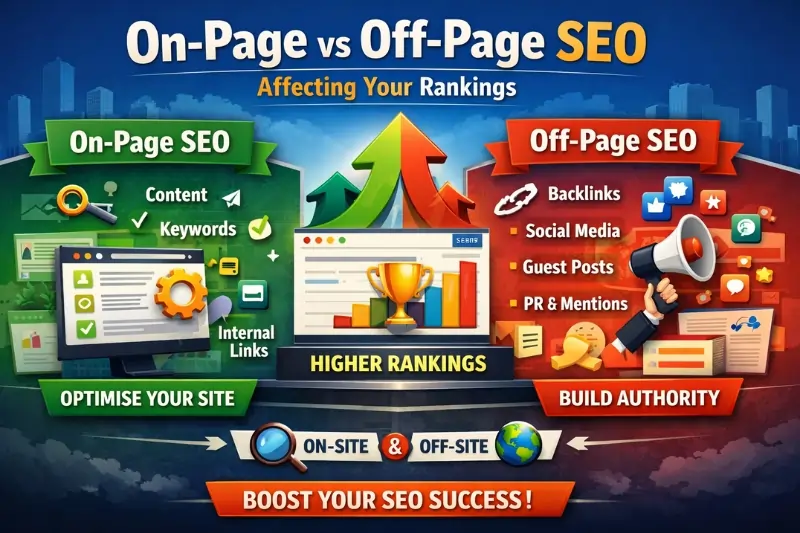
That is off-page SEO. You need internal excellence. And you need external validation. That is the real difference between on-page SEO and off-page SEO.
What Is On-Page SEO? Pathway to Visibility
On-page SEO refers to everything you control directly on your website.
It includes:
- Content quality
- Keyword optimisation
- Page structure
- Internal linking
- Technical performance
- Mobile optimisation
- User experience design
When search engines crawl your page, they ask: “Is this page useful, relevant, authoritative, and easy to understand?” On-page SEO ensures the answer is a confident ‘yes’. Let’s dive into each layer.
1. High-Quality Content: The Strategic Foundation
Content is not simply important – it is foundational. You can build backlinks. You can optimise technical performance. You can promote aggressively. But without high-value content, rankings will never sustain momentum.
High-quality content:
- Solves real-world problems
- Aligns with user intent
- Demonstrates expertise
- Provides depth without overwhelming
- Eliminates fluff
- Builds trust
For example, if someone searches “Best laptops for students 2026”
They expect:
- Clear comparisons
- Budget-friendly options
- Battery life analysis
- Performance benchmarks
- Pros and cons
- Honest, experience-based recommendations
They do not want:
- Thin paragraphs
- Keyword stuffing
- Generic advice
Modern search algorithms reward helpful, experience-driven content. This aligns with E-E-A-T principles:
- Experience
- Expertise
- Authority
- Trust
Search engines increasingly favour content created by people who genuinely understand their topic. Value is the key to visibility.
2. Search Intent: The Hidden Boost to Rankings
Search intent is one of the most underestimated SEO services.
There are four main types:
Informational
- “What is SEO?”
- “How does Google ranking work?”
Navigational
- “Facebook login”
- “Amazon official website”
Transactional
- “Buy wireless headphones online.”
- “Order protein powder.”
Commercial Investigation
- “Best CRM software 2026”
- “Top SEO tools comparison”
If someone wants to purchase, don’t deliver a 2,500-word theory essay. If someone wants information, don’t aggressively push a product.
When intent aligns with content:
- Bounce rate decreases
- Dwell time increases
- Conversion rates improve
- User satisfaction rises
- Rankings strengthen
Search engines monitor behavioural patterns. Matching intent sends strong relevance signals. Strategic empathy starts with aligned intent.
3. Strategic Keyword Optimisation: Precision Without Excess
Yes, keywords still matter. But repetition without purpose does not.
Search engines now understand:
- Semantic meaning
- Topic clusters
- Contextual relationships
- Synonyms and variations
Instead of repeating “on-page SEO vs. off-page SEO” excessively, incorporate:
- Long-tail keywords
- Related phrases
- Conversational queries
- FAQ-based variations
- Semantic expansions
Place primary keywords in:
- Title tag
- H1 heading
- Subheadings
- Meta description
- First 100 words
- Image alt text
- URL structure
But prioritise readability and keep it clear and readable.
4. Title Tags and Meta Descriptions for Your Digital Stage
Your title tag is your first impression in search results.
It should be:
- Compelling
- Clear
- Keyword-optimised
- Under 60 characters
For example: On-Page SEO vs. Off-Page SEO: Which One Actually Affects Rankings?
Meta descriptions don’t directly influence your rankings, but they can indirectly influence them. Your meta description is where you can make your link sell itself. If your meta description is well written, more people will click on your link, and when that happens, search engines see that people are interacting with your page, and that can do a little good. Sort of like the front window of a shop, you’re having nobody come in. You might have the best content in the world, but nobody’s going to know it if nobody clicks on it because you’re not attracting anyone in with a good “window”.
5. Content Structure: The Psychology of Readability
Online users scan before they read. Formatting matters because attention spans are limited.
Use:
- Short paragraphs
- Strategic subheadings
- Bullet points
- Numbered lists
- Clear transitions
- White space
Readable content reduces friction. Reduced friction increases:
- Scroll depth
- Time on page
- Engagement
- Return visits
Structural choices reflect functional strategy, not aesthetics.
6. Internal Linking: Building Topical Authority
Internal links connect your content into a structured ecosystem.
They help with:
- Help search engines crawl efficiently
- Pass authority between pages
- Guide users deeper into your site
- Establish topical clusters
For example, if you write about SEO fundamentals, link to:
- Keyword research tutorials
- Technical SEO checklists
- Content marketing guides
- Link-building strategies
Internal linking signals depth and thematic consistency. It transforms scattered posts into a strategic knowledge hub.
7. Technical SEO: Boost Site Performance
Technical SEO is invisible to most users – but critical for rankings.
Search engines evaluate:
- Page speed
- Core Web Vitals
- Mobile usability
- Secure HTTPS
- Crawl errors
- XML sitemaps
- Structured data
A slow site kills conversions. Research consistently shows that users abandon pages after just a few seconds of delay.
Improve speed by:
- Compressing images
- Using caching systems
- Minimising JavaScript
- Selecting reliable hosting
- Reducing unnecessary plugins
Technical excellence builds credibility and efficiency.
8. Mobile-First Optimisation
Google now uses mobile-first indexing. Your mobile version is evaluated before the desktop version.
Your site must:
- Be fully responsive
- Use readable font sizes.
- Provide intuitive navigation
- Avoid intrusive pop-ups
- Load quickly on mobile networks
Mobile optimisation is not optional. It is foundational.
9. User Engagement Signals
Search engines measure behavioural indicators:
- Click-through rate
- Time on page
- Pages per session
- Bounce rate
- Return visits
If users click and immediately leave, it signals dissatisfaction. Engaging content combined with an intuitive design creates positive behavioural signals. Positive signals strengthen rankings.
What Is Off-Page SEO? The Power of Digital Reputation
If on-page SEO builds your internal strength, off-page SEO builds your external credibility. Off-page SEO includes actions outside your website that influence rankings.
It enhances:
- Authority
- Trust
- Brand visibility
- Domain credibility
Search engines ask: “Do others recognise this site as valuable?” If the answer is yes, rankings improve significantly.
1. Backlinks: The Authority Advantage
Backlinks remain one of the strongest ranking factors. A backlink is essentially a digital endorsement. But remember: quality outweighs quantity.
Search engines analyse:
- Domain authority
- Relevance
- Anchor text
- Placement context
- Linking patterns
A contextual backlink from a respected publication carries immense value. Spammy links? Risky and counterproductive.
2. Earning Links Through Exceptional Value
The most sustainable backlinks are earned.
Create:
- Original research
- Data-driven insights
- Comprehensive guides
- Unique frameworks
- Infographics
- Free tools
People link to remarkable resources. Shortcuts may produce temporary spikes, but authentic value produces lasting growth.
3. Brand Mentions and Digital PR
Unlinked brand mentions count towards authority.
When your brand is in:
- News articles
- Industry blogs
- Podcasts
- Online forums
- Social conversations
Search engines start to see that your brand is gaining in prominence. Digital PR can help with that even more. The more people see you, the more they trust you, and the higher you rank.
4. Social Media Amplification
Social media won’t boost your rankings directly, but it does increase reach.
They help with:
- Helps you get more exposure
- Drives referral traffic
- Helps people share your content
- Creates more backlink opportunities
Distributing multiples. The more people see you, the more authority you gain.
5. Guest Posting and Partnerships
Premium guest posting:
- Expands reach
- Builds thought leadership
- Earns contextual backlinks
- Builds credibility
Keep in mind relevance and authenticity. Partner with voices you trust in your niche.
6. Reviews and Reputation
Reviews have a huge impact on local businesses and e-commerce sites.
The more positive reviews you have:
- Increase Credibility
- Raise click-through rates
- Impact purchasing choices
- Boost local search rankings
Reputation builds on itself. Credibility is a ranking factor.
On-Page SEO vs. Off-Page SEO: The Symbiotic Strategy
On-page SEO declares, “This content is valuable.” Off-page SEO confirms: “Others agree.” If you have strong content but no authority, growth is slow. If you have authority but weak content, visitors leave. Sustainable SEO requires both.
The highest-ranking websites combine:
- Deep content
- Optimised structure
- Technical precision
- Trusted backlinks
- Positive user signals
When balance meets action, growth multiplies.
Why Many SEO Strategies Collapse
Common mistakes include:
- Expecting immediate results
- Ignoring technical SEO
- Publishing thin content
- Buying low-quality backlinks
- Neglecting content updates
- Overlooking mobile experience
SEO is not a campaign. It is a continuous investment.
How Long Does SEO Take?
SEO requires patience. Typical timeline:
- 3–6 months for initial traction
- 6–12 months for measurable authority
- 12+ months in competitive industries
Unlike paid advertising, SEO compounds. It builds digital equity. It transforms your website into a long-term asset.
Advanced SEO Strategies for Competitive Dominance
To elevate your performance, focus on:
- E-E-A-T enhancement
- Topic clusters
- Semantic SEO
- Structured data markup
- Featured snippet optimisation
- Core Web Vitals improvement
- Competitor gap analysis
- Content refresh cycles
- Entity-based SEO
Modern SEO is holistic. It blends creativity with precision.
The Transformational Benefits of Mastering SEO
When on-page and off-page SEO align, you gain:
- Sustainable organic traffic
- Increased brand credibility
- Higher conversion rates
- Reduced dependency on ads
- Stronger competitive positioning
- Scalable digital growth
Start with SEO, gain momentum, and establish authority.
Final Thoughts: Plan Your SEO Strategy
There is a difference between on-page and off-page SEO, but to know it is not merely learning theory but an empowerment of strategy. On-page optimisation builds your internal presence, whereas off-page optimisation builds your external presence. And working in sync with each other, search engines return to you with visibility, credibility and traffic.
Start small:
- Optimise one page thoroughly
- Improve one headline
- Enhance one internal link structure
- Earn one authoritative backlink
- Update one outdated article
At OptiRank, consistency compounds, patience multiplies and strategic execution prevails. Over time, your traffic will increase – not because of luck – but because you engineered visibility with intelligence and purpose. That is the true power of mastering on-page SEO and off-page SEO together.
Frequently Asked Questions (FAQs)
Do small businesses need both on-page and off-page SEO?
Yes. Both on-Page and off-Page are vital as on-page seo fixes the technical aspect of the website such as content and structure whereas off-page builds authority through backlinks. Both work in parallel to increase rankings and visibility.
Which is more important: on-page SEO or off-page SEO?
Both are very important as on-page makes sure that the website is well optimised so that Google can read clearly whereas off-page builds trust and authority. To rank in the top 3, it’s important to have both.
Can you rank with only on-page SEO?
Yes. But you can only rank on low-competitive keywords as for high-competitive keywords you need high authority to achieve high rankings.












2 Responses
Totally agree with the frustration of having great content and a solid design but still seeing minimal traffic. SEO is definitely the missing piece, and understanding both On-Page and Off-Page strategies is key. It’s not just about creating great content – it’s about making sure your site is visible and trusted by search engines!
Thanks for breaking down the distinction between on-page and off-page SEO—it’s easy to get caught up in one area while neglecting the other. I’ve seen too many businesses invest heavily in content creation only to overlook technical SEO elements or backlink strategies, which ultimately limits their visibility. It really does take a balanced approach to see sustainable growth in rankings.