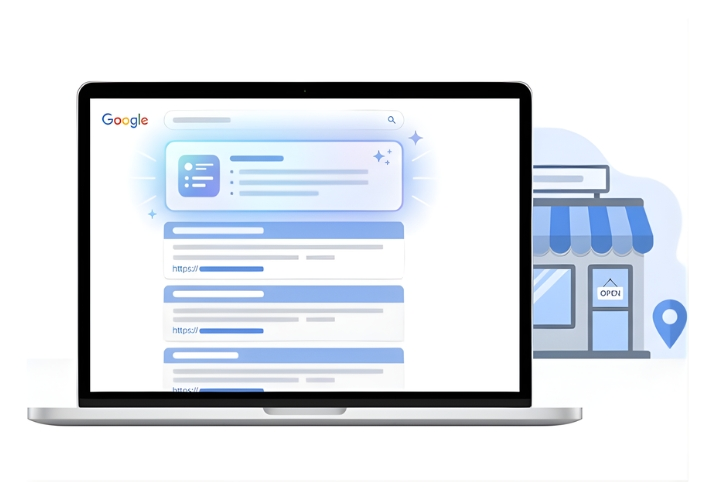
Google AI Overviews have changed the way people find businesses online – and if you’re a business owner, you’ve probably already felt it. Maybe your website traffic dropped without any obvious reason. Maybe you noticed that Google is now showing a big chunk of text at the top of search results before users even see your website link. That’s AI Overviews at work.
The good news is this isn’t the end of organic search for small and medium businesses. It’s just a shift – and the businesses that understand it early will have a real edge over those that don’t.
This guide breaks down what Google AI Overviews actually are, how they’re affecting businesses, and what you can do right now to stay visible in search results.
Google AI Overviews – What Are They and Why Do They Matter?
Google AI Overviews are AI-generated summaries that appear at the very top of Google search results. Instead of showing you a list of links, Google now pulls information from multiple sources across the web and generates a direct answer to the user’s query.
Think of it as Google trying to answer the question itself, rather than sending users to a website to find the answer.
Here’s what you need to know about them:
- They appear above all organic results, including position one
- They pull content from multiple websites, not just one
- They include citations and links back to sources
- They show up for both informational and local/commercial searches
- They are becoming more common across Australian search results in 2026
Google confirmed that AI Overviews now reach over 1.5 billion users monthly and have driven a significant increase in complex, multi-step search queries – according to Google’s official search update.
For business owners, this means users can get an answer without ever clicking through to your website. That directly affects your traffic – but it also creates a new opportunity to be one of the sources Google cites.
How Google AI Overviews Are Affecting Businesses
If you’ve seen a drop in organic traffic over the past year, AI Overviews could be a contributing factor.
Studies suggest AI Overviews now appear in nearly half of all Google searches. That number is growing, and Australian search results are following the same trend.
The industries feeling this the most include:
- Tradies and home services – users searching “best plumber” now get an AI-generated summary before any business listings
- Finance and mortgage brokers – common questions about home loans, interest rates, and broker fees are being answered directly by Google
- Education and migration agencies – visa information and course comparisons are being summarised in AI answers
- E-commerce stores – product comparison queries are increasingly handled by AI before users see any shop links
The click-through rate on organic results below an AI Overview is noticeably lower. Users are getting the gist of an answer at a glance, and only the most relevant or trusted sources get cited in the overview itself.
What Is GEO (Generative Engine Optimisation)?
You’ve probably heard of SEO – search engine optimisation. GEO, or generative engine optimisation, is the newer practice of optimising your content so it gets picked up and cited by AI-generated search results.
Traditional SEO focuses on getting your page to rank in the top 10 blue links. GEO focuses on making your content the kind that AI systems like Google’s Overview, ChatGPT, and Perplexity actually reference when answering questions.
For businesses, this means thinking about content differently. It’s no longer just about keywords – it’s about being genuinely helpful, well-structured, and trustworthy enough that an AI system chooses your content as a source.
The core principles of GEO include:
- Writing content that gives direct, clear answers to questions
- Using well-organised formatting with headings and bullet points
- Demonstrating real expertise, experience, and authority in your field
- Getting mentioned or linked to by other credible Australian websites
- Keeping your information accurate and up to date
How to Get Your Business Found in Google AI Overviews
This is the practical part. Here’s what actually works.
1. Answer Questions Directly and Clearly
AI systems look for content that gets straight to the point. If someone searches “how long does local SEO take,” your content should answer that in the first two or three sentences – not three paragraphs in.
A good rule of thumb: write your H2 headings as questions, then answer them immediately below.
2. Use Clean, Structured Formatting
Google’s AI pulls content that’s easy to read and well-organised. That means:
- Short paragraphs (two to three lines at most)
- Bullet points and numbered lists where appropriate
- Clear H2 and H3 headings that reflect what each section covers
- Bold text for key terms and takeaways
Walls of text are harder for AI systems to process. Keep it clean and scannable.
3. Optimise Your Google Business Profile
For local businesses, your Google Business Profile is one of the most important signals for appearing in local AI Overviews and map results.
Make sure you:
- Keep your business name, address, and phone number consistent across every platform
- Add your full range of services with detailed descriptions
- Collect reviews regularly and respond to every one of them
- Post updates or news at least once a fortnight
A well-maintained profile tells Google that your business is active, trustworthy, and relevant to local searches.
4. Build E-E-A-T Signals
E-E-A-T stands for Experience, Expertise, Authority, and Trust – and it’s one of the main factors Google uses to decide which sources it features in AI Overviews.
For a business, you can build E-E-A-T by:
- Adding an author bio to your blog posts that mentions real credentials or experience
- Linking to credible Australian sources like government websites or industry bodies
- Showcasing real client results and case studies on your website
- Getting featured in local publications or industry blogs
5. Target Conversational and Long-Tail Keywords
AI Overviews are triggered mostly by conversational, question-based searches – the kind people type when they’re genuinely looking for guidance.
Instead of only targeting “local SEO,” also target:
- “How do I rank my business on Google Maps?”
- “What does local SEO cost for a small business?”
- “Why isn’t my business showing up on Google?”
These longer phrases match how real people search, and they’re exactly the type of queries that trigger AI-generated answers.
6. Add Schema Markup to Your Website
Schema markup is code added to your website that helps Google understand what your content is about. For AI Overviews and local search, the most useful types are:
- FAQ schema – marks up your frequently asked questions so Google can pull them directly
- Local business schema – confirms your name, address, phone, and opening hours
- Review schema – displays star ratings in search results and signals credibility
If you’re not technical, your web developer or SEO agency can handle this. It’s one of the more overlooked tactics that genuinely makes a difference.
Local SEO and AIO: Why They Work Best Together
Some businesses assume that because AI Overviews are taking over, local SEO doesn’t matter as much anymore. That’s actually the opposite of what’s happening.
AI Overviews for local searches still pull from locally relevant, trusted sources. A business with strong local SEO signals – consistent citations, a well-optimised Google Business Profile, local backlinks, and suburb-level content – is far more likely to be featured in AI-generated answers for searches.
A few things that reinforce local authority:
- Add suburb-specific content to your website (not just your city but nearby suburbs like “Southbank,” “St Kilda,” “Richmond,” etc.)
- Get listed on Australian directories like True Local, Yellow Pages Australia, and Yelp AU
- Build backlinks from locally-based websites and local news outlets
- Make sure your name, address, and phone number are identical everywhere it appears online
Common Mistakes Businesses Make With Google AI Overviews
A lot of businesses are unknowingly making it harder for Google to feature their content. Here are the most common issues:
- Writing long, unstructured blog posts with no headings or bullet points
- Leaving their Google Business Profile incomplete or rarely updated
- Ignoring FAQ sections on service pages and blog posts
- Only targeting short, generic keywords instead of question-based phrases
- Not having schema markup on their website
- Having a slow or mobile-unfriendly website
- Publishing thin content that doesn’t actually help the reader
Quick AIO and GEO Checklist for Businesses
Before you publish your next piece of content, run through this:
- Does your opening paragraph answer the main question directly?
- Are your headings written as clear topic statements or questions?
- Have you kept paragraphs to two or three lines?
- Is your Google Business Profile complete and recently updated?
- Does your page have FAQ schema and local business schema?
- Have you linked to at least one credible Australian source?
- Is your website loading quickly on mobile?
Frequently Asked Questions
What are Google AI Overviews?
Google AI Overviews are AI-generated summaries that appear at the top of Google search results. They pull information from multiple trusted sources to give users a direct answer, without requiring them to click through to a website.
How do I get my business featured in Google AI Overviews?
Focus on writing content that directly answers common questions in your industry, use structured formatting, add FAQ and local business schema to your website, and build your E-E-A-T signals through genuine expertise and credible backlinks.
Are Google AI Overviews affecting local businesses?
Yes. Industries like trades, finance, education, and e-commerce are seeing lower click-through rates as AI Overviews answer queries before users reach business websites. However, businesses with strong Google Business Profiles and well-optimised local content can still appear as cited sources.
What is the difference between SEO and GEO?
Traditional SEO focuses on ranking your pages in the list of blue links on Google. GEO (generative engine optimisation) is about structuring your content so that AI systems – including Google’s AI Overviews – choose it as a source when generating answers.
Do I still need SEO if Google AI Overviews are taking over?
Absolutely. Traditional SEO and GEO work together. A strong SEO foundation – fast site, quality content, local signals, backlinks – is still what determines which sources AI systems trust and cite. Skipping SEO makes it harder to appear in AI-generated results, not easier.
Wrapping Up
Google AI Overviews aren’t something to panic about – but they do require a change in how you think about your online presence. The businesses that create genuinely helpful, well-structured content will find themselves cited in AI answers, not buried beneath them.
If you’re not sure how well your website is set up for 2026 search results, a site audit is a good place to start. OptiRank offers a free SEO audit for businesses – get a clear picture of where your visibility stands and where to focus first.