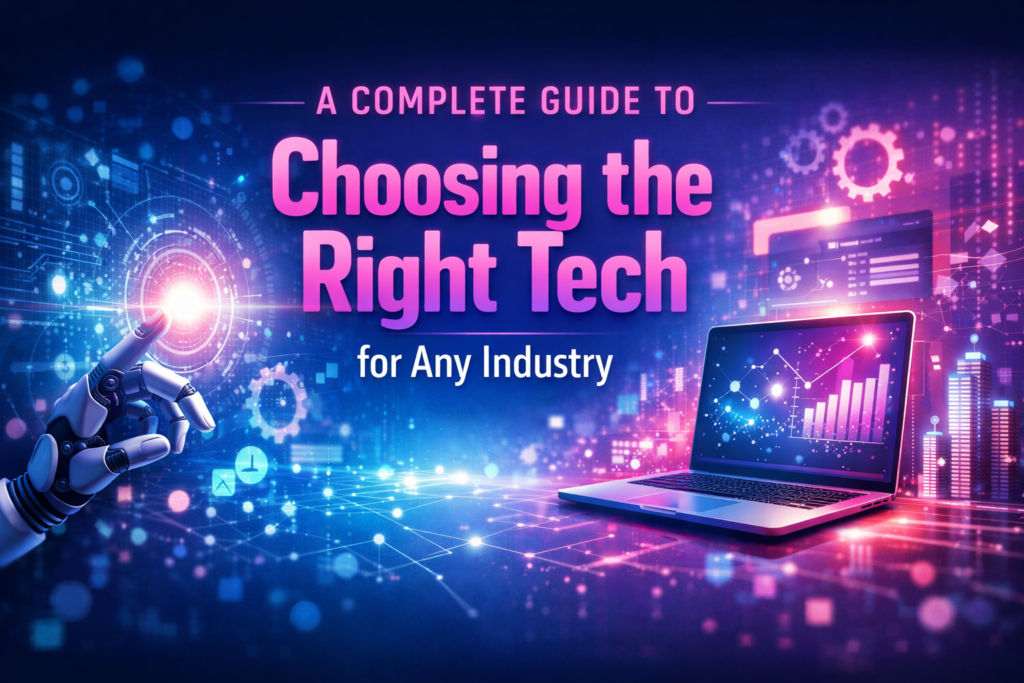
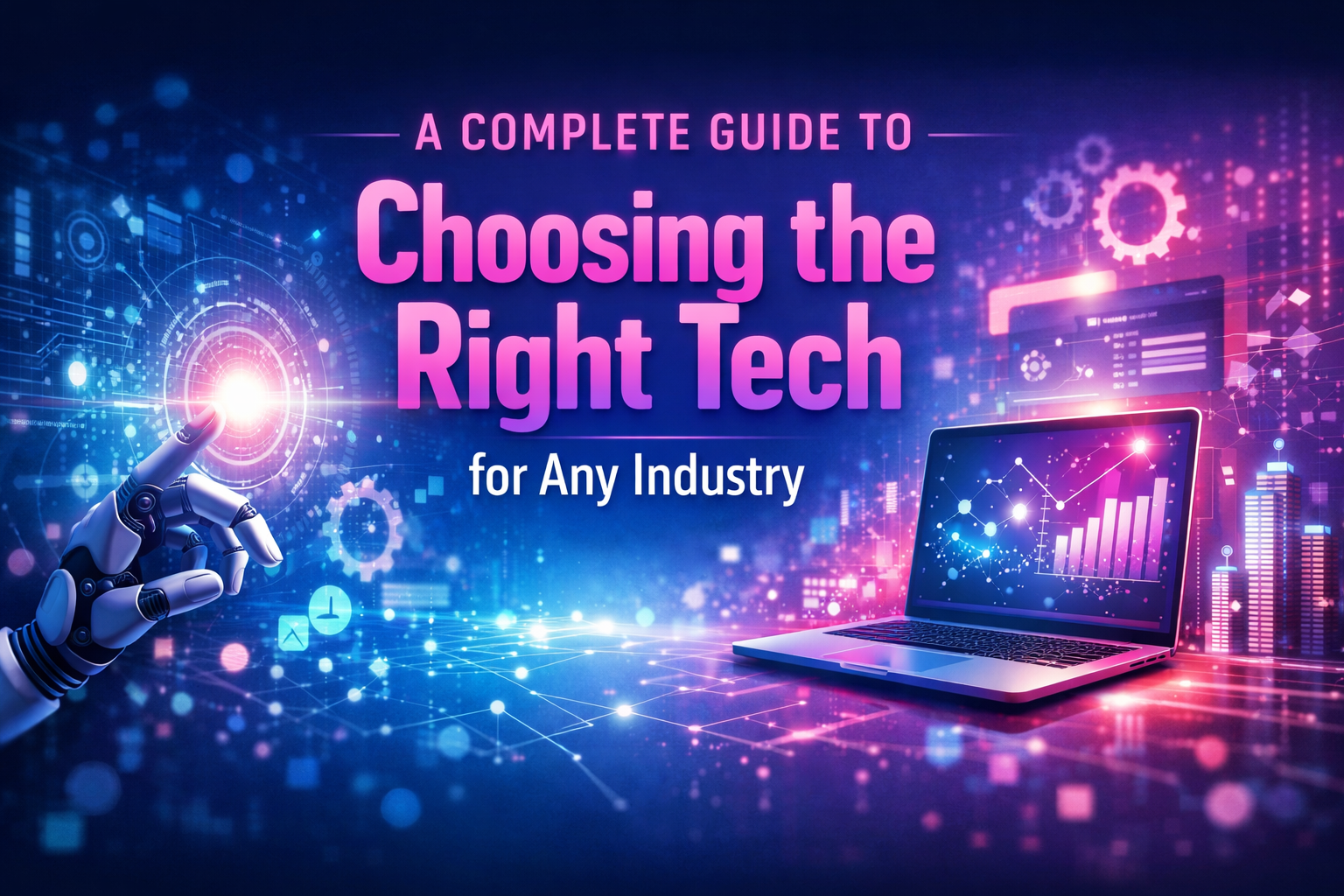
Technology is no longer something businesses “add on” when they have the time or budget; it is now a fundamental part of their operations. Today, it’s the bloodstream of nearly every industry — from retail and hospitality to healthcare, real estate, finance, construction, and everything in between. Whether you’re a small business owner trying to modernise processes or an established enterprise preparing for your next stage of growth, choosing the right tech is one of the most defining decisions you’ll make.
However, the reality of the matter lies herein: in the tech world, there is a lot of noise. Each product will have a promise of quicker results, increased efficiency, reduced costs or some sort of magic-button automation. And, as most businesses in Melbourne have found out, choosing the right tech can make you go faster rather than slower.
7 Simple Steps to Choosing the right Tech for Industry
At Optirank, we see this dilemma every day. Clients come to us already overwhelmed by options and just want to choosing the right tech that works in their industry and at their growth level. Here’s how to do it.
1. Begin with Your Actual Issue – Not the Fancy Tool by choosing the right tech
The greatest error that businesses commit by not choosing the right tech without having an idea of what they require it to do. A restaurant can believe that they need a new POS system, yet their issue is that they are slow in tracking orders and tables.
A luxury retailer might believe that it should have a new website when what it really requires is that the inventory should match between online and physical retail sales. A business whose nature is based on services may seek a CRM when, in fact, what they require is automation, which will save time on administration.
Diagnose the pain point before examining the tools. Ask:
- What is slowing your business down nowadays?
- Which activities are the most time-consuming or expensive to do manually?
- What do customers most complain about?
- What are the areas of occurrence of human errors?
- What does the competition do better?
Once you know the problem you need to solve well, then selecting tech is not a big deal since you are solving something, not following trends.
2. Choosing the right Tech that Knows the Beat of Your Industry
Each industry works at its own speed, having its own problems and customer demands.
- E-commerce is fast, with accurate stock information, and user-friendly.
- Healthcare requires safety, conformity, consistency, and transparency of data.
- Hospitality requires quick transactions, optimisation of table rotation and a great flow of customers.
- Building is based on the tracking of the project, its schedule, and its report.
- Real estate relies on CRM intelligence, lead development and automated communication.
Before investment, the question is: Is this tool a true expert in how my industry functions? Look for:
- Industry-specific features
- Integrations to suit your workflow.
- Support of adherence (essential in finance, healthcare, and education)
- Business success stories of your customers.
- A growth strategy in line with the transformation of your industry.
Generic tools will work, but industry-specific tools generally have fewer headaches and work faster and better.
3. Check Scalability: Will This Tech Still Work When You Grow?
What may have worked with a business of 5 employees may not in any way work with a business of 50 employees.
During technology selection, one considers:
- User limits
- Storage limits
- Workflow complexity
- Automation capacity
- API availability
- Upgrade paths
Consider technology as a long-term employee. You do not want someone who is going to become outdated within a year.
It is pointless to install a CRM that turns out to be costly as you grow larger or an ERP that demands a full new migration as you commence diversification. The finest technology must not be a patch but a proper building block.
4. Make Tools That Integrate a Priority
Disconnected systems are one of the largest productivity killers that we observe in businesses. On one corner, you have your CRM. Your tasks are in another. Your POS is somewhere else. Your accounting software is in the distance. Web analytics in another world. Your team spends more time changing tabs than solving problems.
The appropriate technologies must communicate with one another. Integrations help establish a perfect flow of information between:
- Sales
- Marketing
- Customer service
- Inventory
- Finance
- Operations
You should select tools that provide native integrations or open APIs – this will allow you to be flexible, and it will save on future development.
A related system is not only convenient; it also removes errors, quickens the decision-making process and provides a better perspective of your business.
5. Test Before You Commit
No one should be as great as they are on paper, and that is where your real experience counts more.
Always:
- Use free trials
- Request demos
- Let your team test it.
- Evaluate ease of use
- Count the number of steps saved.
- Evaluate the speed of adaptation by your employees.
A tool that needs a masterclass to operate will be discarded sooner or later. An intuitive tool is easily incorporated into your day-to-day work.
Make a list of short ones, evaluate them against each other and choose the one that suits your pace, not one that has the highest number of features.
6. Security, Support and Updates
Good technology is one that does not merely work with the current times but remains reliable, secure and up-to-date.
In the review of options, look:
- The frequency with which the company updates.
- The local or overseas nature of support.
- Security certifications
- Data backup processes
- Downtime history
- Data ownership and privacy policy.
There are high costs to data mishandling for Melbourne businesses, particularly those involved in finance, legal, healthcare and education. Never forget to ensure that the technology you are using is security-conscious.
7. Hire Experts with Tech and Industry Knowledge
In case the process of choosing the right tech overwhelms you, you are not alone. We do this at Optirank, where we work with businesses day in and day out. We study your industry, business model, stage of growth, business obstacles, and workflow, and then assist you in choosing the technology that really makes things happen. It is not about the possession of more tools. These are aimed at possessing the right tools.
Conclusion: Select Technology That Does Not Work against You
The competitive edge in a digitalised world is the correct technology. It automates your operations, enhances your customer experience, increases your productivity, and makes you stand out from the crowd of competitors still using old systems.
The selection of appropriate technology is not about following fads but about selecting solutions that have an insight into your industry, as well as about solutions that will help you grow.
If you need assistance with determining the optimal tech stack to use in your industry, then Optirank can take you through the process and guide you through the entire procedure.


























2 Responses
Jiliapps, pretty convenient to play on mobile. The app runs smoothly on my phone, so I can get my game on anywhere. Here’s the place: jiliapps