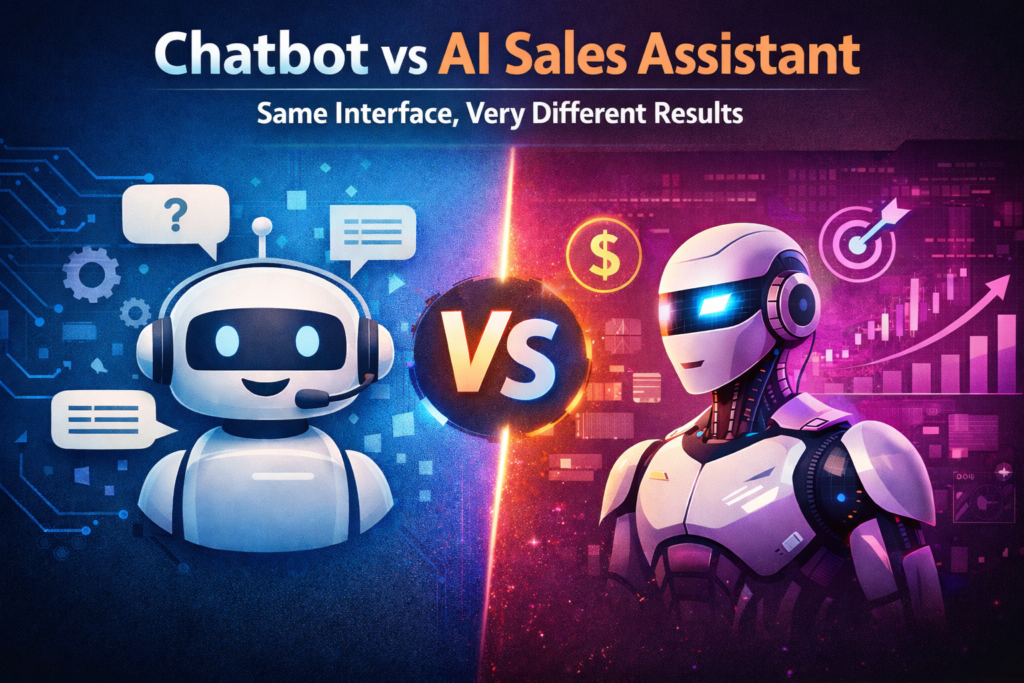
In the modern world, companies are continually being pushed to act more quickly and individually, turning more leads, but without emptying their coffers. Automation tools have entered to rescue, yet there is one condition: many companies begin to perceive two radically different technologies, chatbots and AI Sales Assistant. At a glance, they resemble each other. Both can speak with visitors and respond to questions as well as automate conversations on your site. Easy to confuse, right? However, when you start scratching the surface a bit, the variations in the intelligence, flexibility and the real business impact are quite evident.
When considering the automation of your business to expand, this distinction can help you save time, money and a good deal of frustration. Let’s unpack it.
So… What Exactly Is a Chatbot?
A chatbot is typically a rule-based system, and it works using pre-written scripts or decision trees. It is meant to deal with easily foreseeable conversations. Imagine that it is an online FAQ robot that understands what to say only when the user adheres to the script.
What chatbots are good at:
- Answering common questions
- Disclosing business hours, pricing pages or contact information.
- Referring the visitors to the appropriate department.
- Gathering rudimentary information such as name and email.
- Provision of menu-based navigation.
Chatbots are truly useful in the case of repetitive tasks. They lessen the burden on the support staff, are relatively cheap, can be deployed easily and are not as complex.
Where do conventional chatbots fail?
However, as soon as a discussion becomes a little bit tricky, all may unravel.
- They do not really appreciate context.
- There is little or no personalisation.
- They are infringed when users say something in other ways than they are supposed to.
- They do not develop or learn by themselves.
- They do not often have a significant effect on revenue.
To put it simply, chatbots react; however, they do not think or sell.
What Is So Special about an AI Sales Assistant?
The next level of automation is an AI sales assistant. It does not operate solely on scripts; instead, it utilises artificial intelligence, machine learning and natural language processing to actually comprehend what people intend, how they act and what they are likely to desire next.
It is more like a digital salesperson; instead of merely responding to questions, it will qualify, guide, recommend a solution, and push people towards a decision.
What can an artificial intelligence sales assistant perform?
- Interpret natural language and meaning.
- Observe the behaviour and history of users.
- Individualise live chats.
- Automatically score and qualify leads.
- Sell products or solutions depending on the needs.
- Combine with CRM, analytics and marketing solutions.
- Work 24/7 without burnout
With time, it becomes smarter and analyses what is and is not converting, like traditional chatbots are incapable of doing.
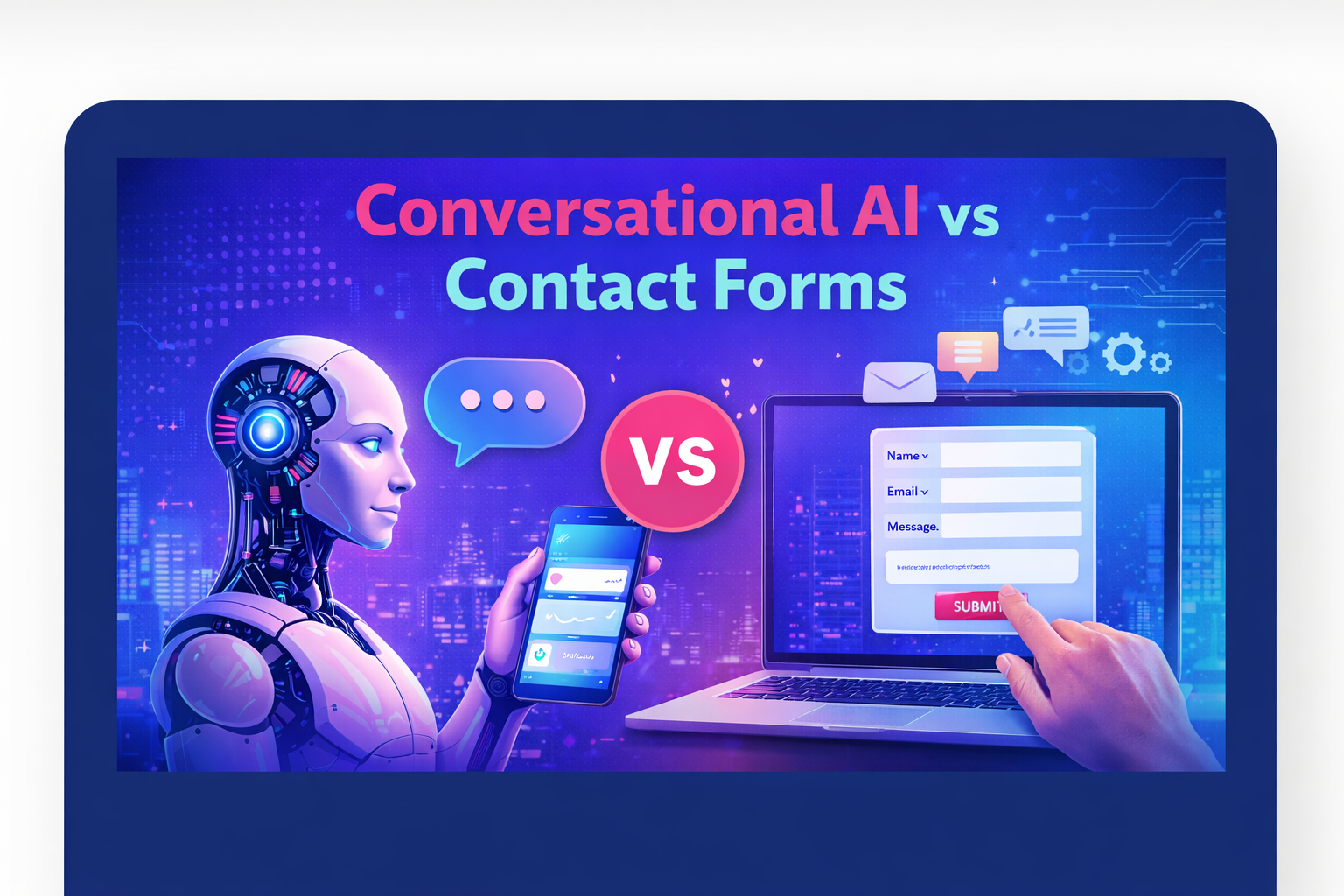
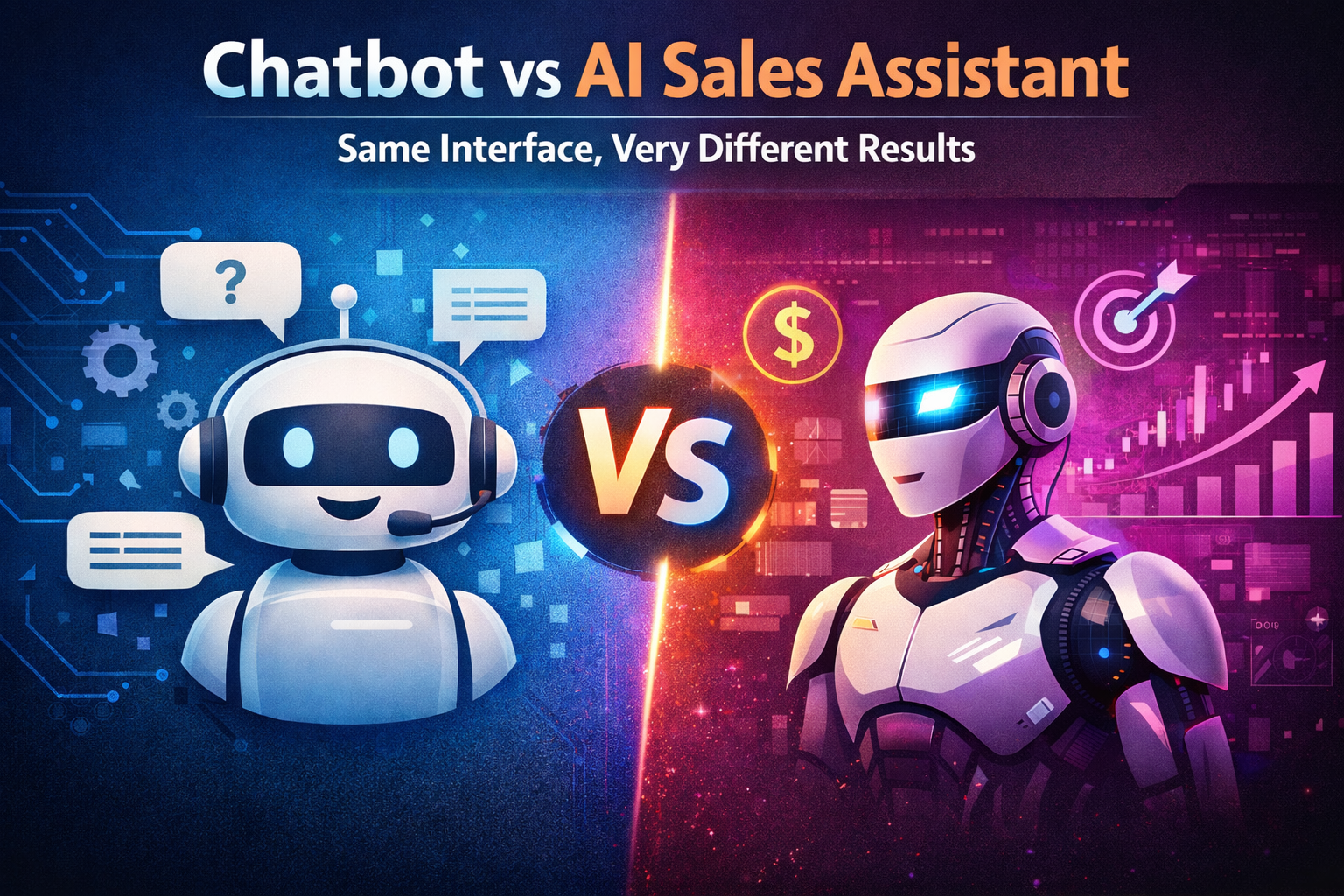
Chatbot and AI Sales Assistant: The True Differences.
1. Intelligence
- Chatbot: Adheres to set rules and scripts. No real adaptability.
- AI Sales Assistant: It is a non-stop learner that refines itself on the basis of data and forecasts.
2. Conversation Quality
- Chatbot: Is frequently rigid, mechanical, and monotonous.
- AI Sales Assistant: It is more natural and aware of context, follow-ups, and intent.
3. Personalisation
- Chatbot: provides all with an equal experience.
- AI Sales Assistant: Customises messages depending on behaviour, place, industry and historical activity.
4. Sales Impact
- Chatbot: Mostly assists in support and simple lead capture.
- AI Sales Assistant: Proactively makes sales by qualifying, farming, and making intelligent suggestions.
5. Learning and Scalability
- Chatbot: It must be manually updated in each new situation.
- AI Sales Assistant: Enhances autonomy and scales intelligence with millions of engagements.
When Is a Simple Chatbot Enough?
The simplest chatbot can most certainly make sense when your company:
- Deals with repetitive questions most of the time.
- Wants slim automation of customer support.
- Has a low or small volume of lead flow.
- Potentially does not need profound personalisation.
- Needs a minimal cost/low-maintenance gadget.
This may be sufficient in the case of informational websites or a business in its initial stages.
When an AI Sales Assistant Makes More Sense
An AI sales assistant will begin to pay off if your business:
- Receives much traffic and inbound leads to the site.
- Automated lead qualification and scoring needed.
- Desires to make more conversions, not only respond quicker.
- Competitive operations in the digital arena.
- Based on evidence-based decision-making.
- Loves customer experience and scale.
Intelligent automation provides significantly better ROI, in case growth and revenue are of concern.
Why Does Optirank Focus on AI Sales Intelligence?
At Optirank, we do not think that automation should be a response to questions, but it should be used to make deals.
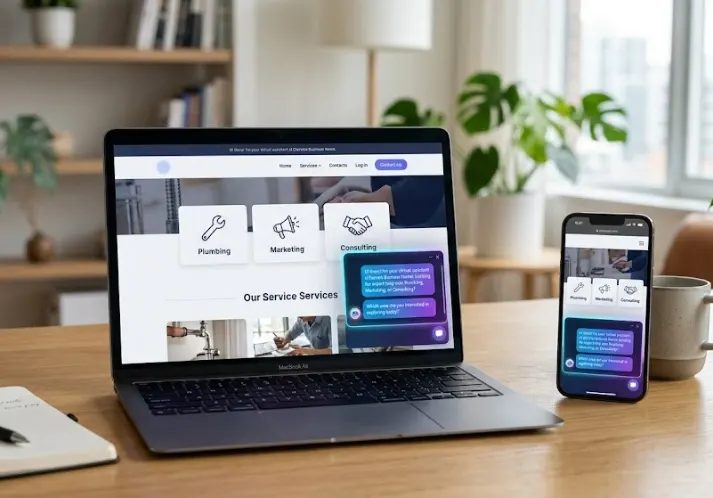
Our sales assistant is an AI-powered platform that converts traffic to the site into qualified sales opportunities through the combination of behavioural knowledge, smart dialogues, and predictive analytics. Rather than handling all visitors in the same manner, Optirank identifies intent and will change its messages on the fly to increase engagement and conversions.
How we think about Sales Automation at Optirank
- Smart visitor identification – identifies high-intent users in real time.
- Behavioural personalisation – messages are modified based on what customers actually do.
- Auto lead qualification – filters serious customers out of random shoppers.
- Integrations of CRM and marketing for seamless movement of data between platforms.
- Constant optimisation – the performance is improved automatically.
- 24/7 revenue engine – is operable even in situations when your staff is not online.
Optirank does not take over the sales team. It helps them with warmer leads and clearer visions – to make your team close and not chase.

The Future of Sales Automation
The difference between the simple chatbots and intelligent sales assistants will continue to expand as AI continues to develop. Those firms that are relying on a mere form of automation might not keep up with their rivals’ smarter and more versatile applications.
Customers of today demand quick replies, the suggestions they make are timely, and the purchasing process is not complicated. It requires more than canned responses to live up to those expectations; it requires systems that are made in such a way that they comprehend people.
Final Thoughts
Yes, chatbots and AI sales assistants automate communication, but not to the same end. Chatbots assist in responding to questions. The AI sales assistants are beneficial in generating revenue.
Provided, that you want to decrease the amount of manual work, a chatbot may suffice. However, when it comes to serious scaling conversions, personalising experience and maximising ROI, an AI sales assistant is the more intelligent long-term decision.
Ready to go beyond basic automation? Optirank helps turn conversations into real conversions.











3 Responses
Gotta love those lucky numbers! 777xk’s design is pretty sharp. Just hoping it translates to winning big time. Worth a peek, eh? Head over here: 777xk
SuperPH777, eh? Sounds like a buzzing place online. Hope they’ve got some good bonuses for the new lads joining and plenty of action to jump into. Find the fun here: superph777